
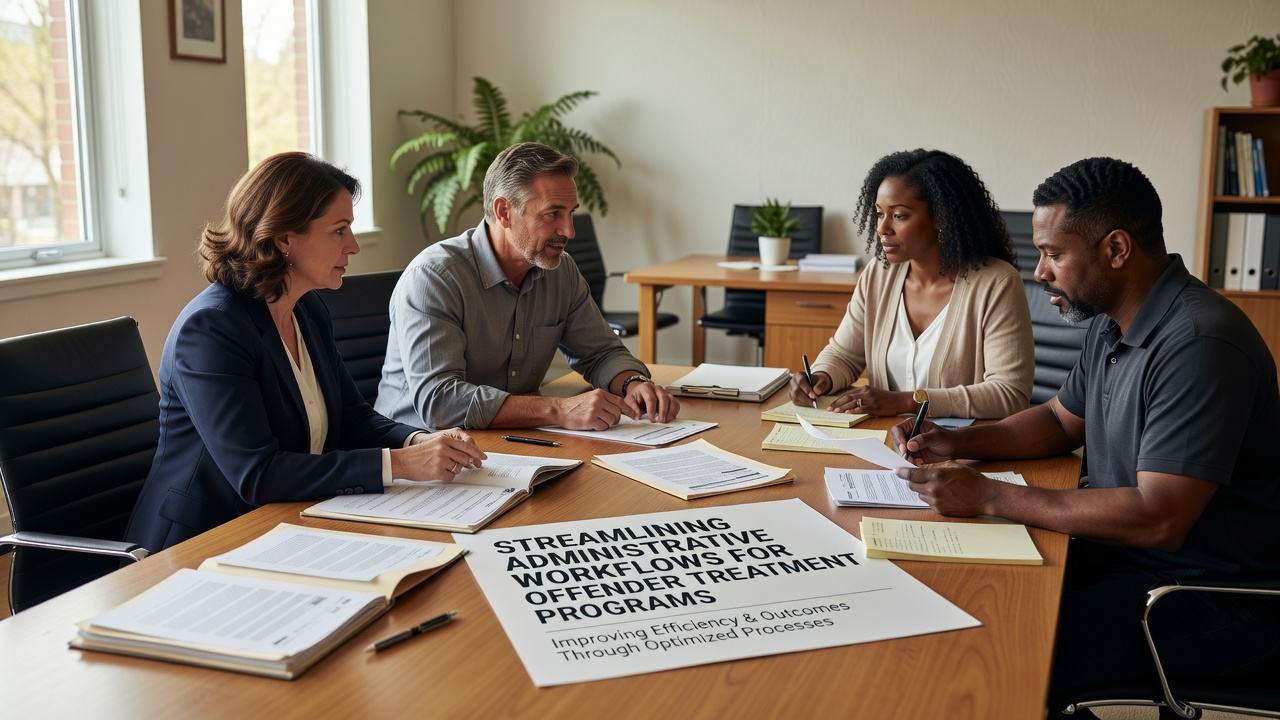
Managing administrative workflows for offender treatment programs is one of the most demanding operational challenges agencies face today. Between documentation requirements, attendance tracking, billing reconciliation, and court reporting deadlines, the administrative burden can easily overwhelm staff — especially at smaller organizations with limited resources. The good news is that most of these pain points are solvable with the right workflows, tools, and review habits in place.
Why Administrative Workflows Break Down in Regulated Programs
Most workflow failures in supervised treatment programs aren’t caused by negligence. They’re caused by unclear ownership, inconsistent processes, and tools that weren’t built for compliance environments.
Some of the most common breakdown points include:
- Missed or late session notes — staff complete sessions but delay documentation, creating gaps that surface during audits
- Unsigned forms and incomplete intake records — often discovered only when a file is pulled for review
- Inconsistent attendance records — especially when multiple staff members log attendance separately without a unified system
- No formal corrections log — when errors are corrected informally, there’s no audit trail to demonstrate record integrity
- Billing that doesn’t align with service delivery — when attendance records and billing aren’t reconciled regularly, payment delays and disputes follow
These aren’t isolated problems. They tend to compound over time, and they’re exactly the kind of issues that trigger findings during formal audits or contract reviews.
Building a Documentation Process That Actually Holds Up
Strong documentation doesn’t require more paperwork — it requires consistent, structured habits built into daily and weekly workflows.
Start with standardized session note templates
When every staff member uses the same format for progress notes, file reviews become faster and more consistent. Templates should capture the required elements for your program type — session date, participant response, progress indicators, staff signature, and any sanctions or changes to the service plan. Standardization also makes it easier to onboard new staff and maintain consistency across multiple sites.
Build a weekly reconciliation habit
One of the most practical steps any agency can take is a weekly reconciliation of attendance, notes, and billing. This means:
- Confirming that every scheduled session has a corresponding note
- Verifying that attendance records match what was billed for the period
- Flagging any unsigned documents before they pile up
- Identifying missing items early enough to correct them without disruption
A weekly rhythm prevents the kind of month-end surprises that delay billing cycles and create compliance gaps.
Maintain a formal corrections log
When a documentation error is corrected, the change needs to be traceable. A corrections log — sometimes called an amendment trail — records what was changed, who made the change, and when. This is a basic requirement in most regulated environments, but it’s frequently missing in agencies that rely on paper-based or informal systems. If your organization doesn’t have a formal corrections process, building one is a high-priority step toward audit readiness.
Staying Audit-Ready Without Constant Fire Drills
Many agencies treat audits as events to prepare for rather than a standard of ongoing operations. That reactive approach creates unnecessary stress and increases the risk of findings. A better model is continuous readiness — maintaining records in audit-ready condition at all times.
A practical way to support this is through a monthly file review checklist. This should include:
- Current and signed progress notes for active participants
- Completed intake and enrollment documentation
- Attendance records reconciled with the billing period
- Documented sanctions, program changes, or case transfers
- Corrections log entries for any amended records
- Verified contact information and referral source documentation
Assigning a specific staff member or coordinator to own this monthly review — rather than leaving it to whoever has time — dramatically improves follow-through.
Handling staff transitions and case transfers
Documentation gaps frequently appear during staff turnover or case handoffs. When a case transfers from one provider to another, or when a staff member leaves and another takes over a caseload, critical context can get lost. Agencies that have a formal handoff checklist — covering open action items, pending documentation, scheduled sessions, and billing status — protect both program continuity and record integrity.
Aligning Billing With Compliance Documentation
For programs that bill based on service delivery, billing accuracy depends directly on documentation quality. If attendance records are incomplete or session notes are missing, billing disputes become much harder to resolve. Worse, overbilling or underbilling tied to incomplete records can create compliance exposure that extends beyond a single contract period.
The most reliable approach is to treat billing reconciliation as part of the documentation process, not a separate administrative task. When your attendance tracking, session notes, and billing records are connected — either through integrated software or a structured manual process — discrepancies are caught early and corrected before they become problems.
Agencies managing compliance tracking for regulated programs often find that purpose-built tools reduce the manual reconciliation burden significantly, particularly when staff are managing large caseloads across multiple service types.
How Software Tools Support Better Workflows
Process improvements get you most of the way there, but the right software makes them sustainable at scale. For agencies managing supervised treatment programs, the most useful tools are those that:
- Centralize participant records in one place accessible to all authorized staff
- Automate deadline reminders for documentation, reporting, and billing periods
- Flag incomplete records before they become compliance issues
- Generate court-ready reports from data already captured in the system
- Maintain a full audit trail for all records, corrections, and submissions
These aren’t luxury features — they’re the difference between an administrative process that runs smoothly and one that requires constant manual oversight to keep from falling apart. Administrative workflow tools for court ordered programs are designed specifically for this kind of regulated environment, where documentation requirements are non-negotiable and audit exposure is real.
Takeaway
The most common administrative problems in supervised treatment programs — missed documentation, billing misalignment, audit unreadiness — are almost always process problems, not staffing problems. Building clear ownership, consistent review cadences, and structured documentation habits into your workflows creates a foundation that holds up under scrutiny. When those workflows are supported by software tools designed for regulated environments, agencies can reduce administrative burden, improve accuracy, and stay compliant without turning documentation into a full-time job.