
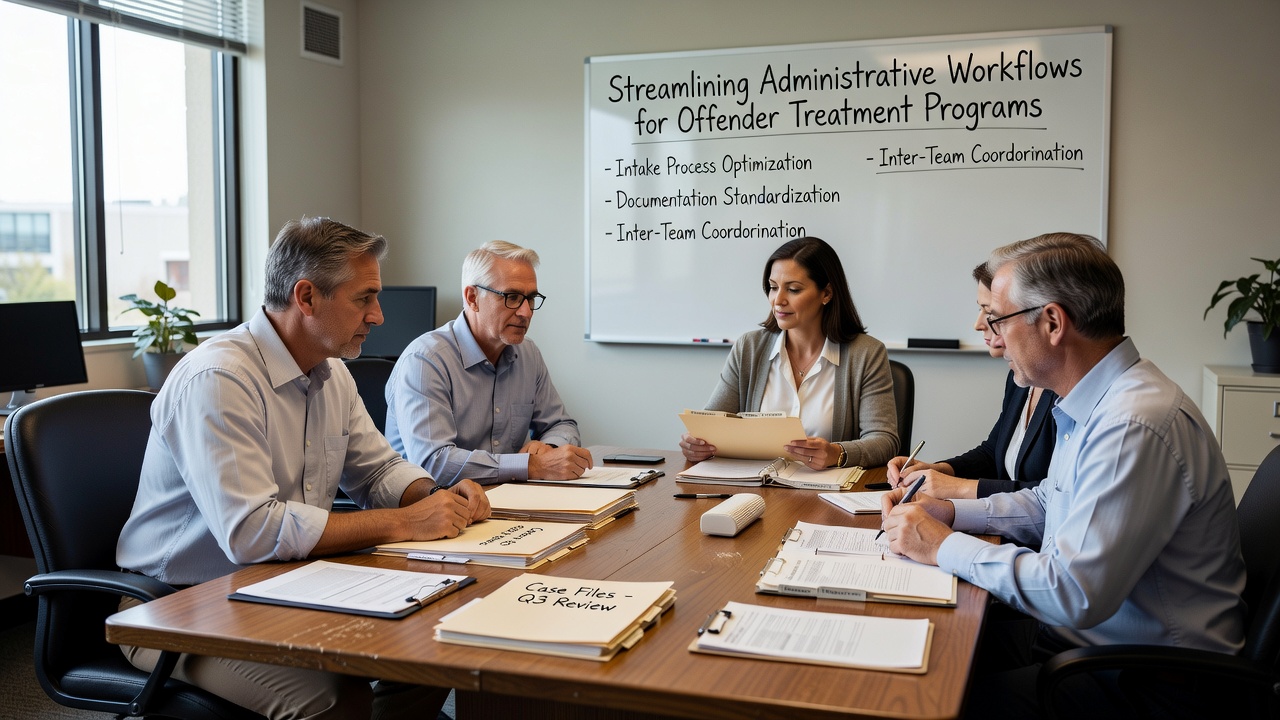
Keeping up with the day-to-day administrative workflows for offender treatment programs is one of the most demanding aspects of running a compliant, court-linked agency. Between progress notes, attendance logs, consent tracking, court reports, and audit preparation, the administrative burden can quickly overwhelm even experienced staff. The good news is that most of these challenges stem from process gaps — and process gaps can be fixed with better workflows, standardized templates, and the right tools.
This guide breaks down the core administrative areas where treatment and supervision agencies most often struggle, and offers practical guidance for building workflows that are efficient, defensible, and audit-ready.
Why Documentation Workflows Break Down
Poor documentation rarely happens because staff don’t care. It usually happens because the process itself is unclear, inconsistent, or too time-consuming to follow under pressure.
Some of the most common documentation failures in regulated programs include:
- Vague progress notes that don’t clearly reflect what happened in a session or why a clinical decision was made
- Missing signatures, dates, or credentials on intake forms, treatment plans, or discharge summaries
- Copy-paste notes that look identical across multiple client records, undermining both clinical quality and legal defensibility
- Late entries that create credibility problems if a record is reviewed in court or during a file audit
- Inconsistent abbreviations or terminology that make records hard to interpret by reviewers unfamiliar with internal shorthand
These aren’t just quality concerns — they’re compliance risks. Regulators and court reviewers look for timeliness, completeness, and consistency across files. Gaps in any of these areas can result in corrective action, warning letters, or reputational harm to the program.
Building a Workflow that Reduces the Risk
The most effective fix is standardization. When every clinician and admin staff member follows the same process for the same document type, errors become easier to catch and correct before they become compliance problems.
Practical steps include:
- Standardize templates for intake assessments, treatment plans, progress notes, incident reports, and discharge summaries
- Use completion checklists tied to each appointment type so required fields aren’t skipped
- Separate clinician tasks from administrative tasks to reduce bottlenecks and prevent staff from taking on work outside their role
- Set internal timeliness standards by document type — for example, progress notes within 24 hours, incident reports same-day, discharge summaries within five business days
Compliance Tracking: Turning Conditions into Trackable Tasks
For agencies working with court-involved clients, compliance tracking means more than checking off attendance. Each client often has individualized conditions of supervision — drug testing requirements, program attendance minimums, prohibited contact orders, or treatment plan milestones — that must be documented and monitored over time.
Without a structured system, these conditions exist only in paper files or staff memory. That creates real risk when a client falls out of compliance and a court or probation officer asks for documentation of the timeline.
A practical compliance tracking workflow should:
- Translate each condition of supervision into a trackable task or milestone with a due date and responsible party
- Use risk flags or alerts to surface missed sessions, positive drug tests, or other non-compliance events before they go unnoticed
- Document remediation steps clearly — what the agency did in response, when, and by whom
- Maintain a running log of contacts with courts, probation officers, or other supervision partners
Agencies that use compliance tracking tools for regulated programs often find that structuring this information digitally makes it far easier to produce accurate status reports on short notice.
Staying Audit-Ready Without Last-Minute Scrambles
One of the most disruptive experiences for any treatment agency is receiving notice of a file review or site visit and realizing the records aren’t in order. Audit preparation shouldn’t be a crisis response — it should be an ongoing practice.
Here’s what a year-round audit-readiness approach looks like in practice:
Monthly and Quarterly Checklist Items
- Random chart audits to catch documentation gaps before an external reviewer does
- Policy and procedure review to confirm alignment with current regulatory requirements (HIPAA, 42 CFR Part 2, state licensing rules)
- Staff training logs updated and accessible
- Consent forms reviewed for validity and completeness
- Data quality checks on attendance, billing, and service records
Assigning Ownership
Checklists only work when someone is accountable for each item. Assign a named owner and a due date for every checklist task. Document completion so that if a complaint or investigation arises, the agency can demonstrate its diligence.
What Reviewers Actually Look For
File reviewers typically focus on a core set of documentation elements: signed treatment plans, dated progress notes, attendance records, consent forms, and discharge summaries. They evaluate whether documents are timely, complete, and internally consistent. A file that has all the right forms but shows a treatment plan signed two months after the start of services, for example, will raise questions.
Information Sharing and Consent Management
Court-linked programs regularly share client information with probation officers, courts, attorneys, and other providers. Managing this process carefully is both a legal requirement and an operational challenge.
For programs serving clients with substance use histories, 42 CFR Part 2 imposes stricter consent requirements than HIPAA alone. A valid consent under Part 2 must include specific elements — the name of the entity disclosing, the entity receiving, the purpose of disclosure, and an expiration date or condition. These consents must be documented and retrievable.
Practical consent management steps:
- Document initial consents at intake, including which entities each client has authorized
- Track which reports have been shared with which parties, and when
- Build a process for revocation so staff know exactly how to handle a client who withdraws consent
- Create standard report formats for routine court and probation communications that share participation and attendance information without disclosing full clinical notes unnecessarily
Using administrative workflow tools for court ordered programs can help agencies manage consent documentation and reporting workflows in one place, reducing the risk of disclosing information without a valid authorization on file.
Takeaway
The administrative side of running a regulated treatment or supervision program is genuinely complex — but most of the common problems are solvable with better structure. Standardized documentation templates, trackable compliance workflows, ongoing audit-readiness practices, and careful consent management all reduce the daily burden on staff while improving the accuracy and defensibility of records.
Modern software tools designed for treatment and supervision programs make it significantly easier to manage these workflows at scale, stay current with reporting requirements, and produce accurate records when courts, auditors, or oversight bodies come knocking. The goal isn’t perfection — it’s a consistent, repeatable process that gives your agency a reliable foundation for everything else it does.
Ready to evaluate your current administrative workflows? Start with a documentation audit: pull five random client files and check them against your own intake, treatment plan, and progress note standards. What you find will tell you exactly where to focus first.