
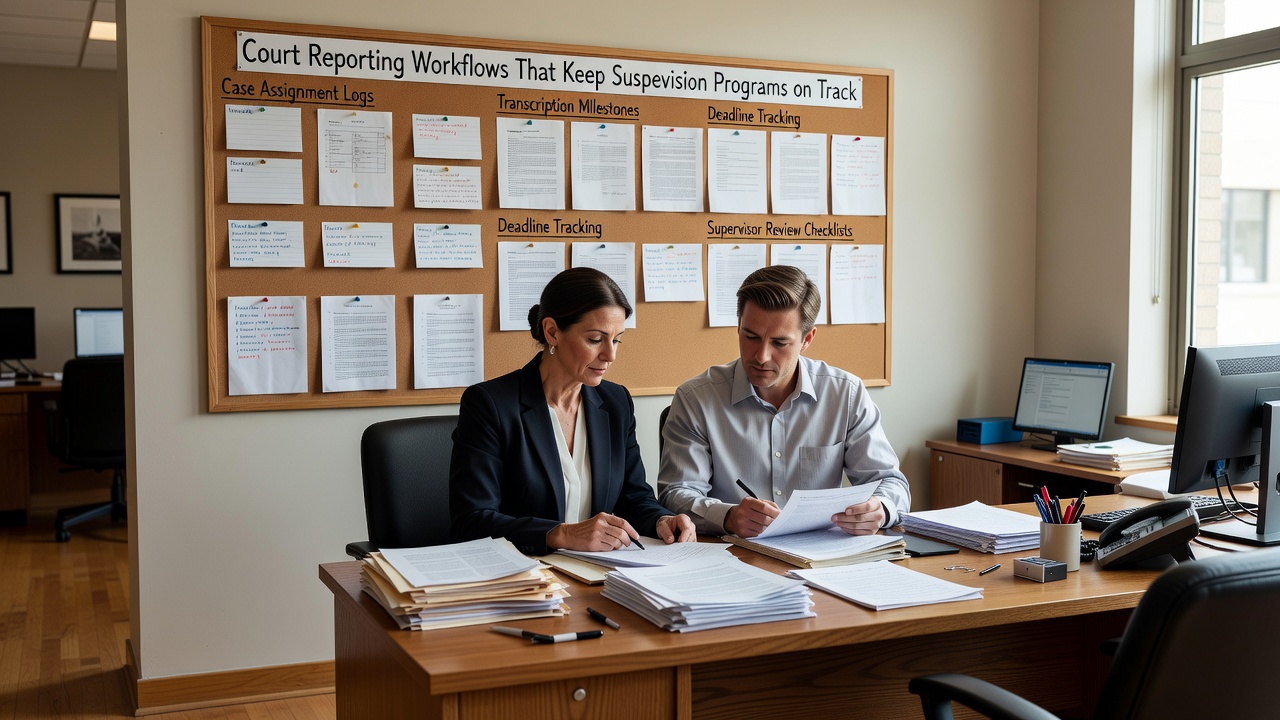
Managing court reporting workflows for supervision programs is one of the most operationally demanding tasks in regulated treatment and compliance environments. When documentation, reporting, and billing processes are not structured clearly, agencies face rework, audit exposure, and missed deadlines that ripple across multiple departments. This guide covers practical habits and workflow structures that help supervision agencies stay organized, reduce errors, and stay ready for review at any time.
Why Reporting Workflows Break Down in Practice
Most documentation problems in regulated programs do not happen because staff are careless. They happen because workflows are unclear, ownership is not defined, or teams rely on informal processes that work fine until they do not.
Common breakdown points include:
- Late or unsigned session notes that delay progress report drafting
- Attendance records that do not match billing entries, requiring manual reconciliation after the fact
- No internal deadline set ahead of external due dates, so reports are drafted under pressure
- No defined approval chain, leaving it unclear who reviews a report before submission
- Missing corrections logs, so auditors cannot confirm what changed in a record and why
Once agencies recognize these patterns, they can build workflow structures that catch problems before they become compliance issues.
How to Structure a Court Reporting Workflow That Reduces Errors
A well-structured reporting workflow has five stages: drafting, internal review, approval, submission, and filing. Each stage should have a clear owner and a defined deadline.
Set Internal Deadlines Before External Due Dates
One of the most practical changes an agency can make is establishing an internal submission deadline that is several days before the external court or agency deadline. This buffer allows time to catch missing information, obtain late signatures, or correct errors without rushing.
For example, if a progress report is due to the court by the 15th of the month, the internal draft deadline might be the 10th, with approval completed by the 12th. This small change reduces last-minute stress and gives supervisors time to review rather than simply sign off.
Assign Clear Ownership for Each Step
Every step in the reporting workflow should have one named owner. When multiple staff members share responsibility without a defined handoff, documents fall through the gaps. Clinical staff may assume case managers are handling submission. Case managers may assume billing staff have already reconciled attendance. Clear ownership eliminates this ambiguity.
A simple internal checklist can define who drafts, who reviews, who approves, and who logs the submission. This does not require complex software to start — but it does require written procedures that everyone follows consistently.
Building a Documentation Habit That Supports Audit Readiness
Audit readiness is not something agencies should prepare for once a year. It is the result of consistent documentation habits maintained throughout the year. Agencies that stay audit-ready treat monthly file reviews and checklist-based chart audits as routine operations, not emergency responses.
What Monthly File Reviews Should Cover
A structured monthly file review helps compliance staff catch documentation gaps before they accumulate. Key items to check include:
- Are session notes completed and signed within the required timeframe?
- Do attendance records align with session notes and billing entries?
- Are required assessments current and on file?
- Have any sanctions or compliance events been documented?
- Are progress reports filed and current in the client record?
- Is there a corrections log that shows what was changed, when, by whom, and why?
Running this review monthly — rather than only before an audit — keeps records current and makes audit preparation significantly faster.
What a Strong Corrections Log Should Include
A corrections log is one of the most overlooked compliance tools in documentation workflows. When a record is changed after the fact, the log should capture what was changed, when the change was made, who made it, and the reason for the correction. Without this trail, auditors have no way to distinguish legitimate corrections from problematic alterations.
This is especially important in programs where client records are reviewed by courts, licensing boards, or accreditation bodies. A well-maintained corrections log signals organizational maturity and makes audits easier to navigate.
Aligning Attendance Records with Billing Accuracy
One of the most common sources of rework in supervised treatment programs is a mismatch between attendance documentation and billing records. When these two data sources are maintained separately — or updated on different schedules — inconsistencies build up and require manual cleanup.
The most effective approach is to use a single source of truth for attendance data. When a session is logged, that entry should feed directly into billing records rather than requiring a separate manual entry. This reduces duplication, limits data entry errors, and makes weekly reconciliation faster.
Weekly reconciliation is a better practice than monthly cleanup. Catching a billing mismatch a few days after a session is much easier than reconstructing attendance records at the end of the month. Agencies that reconcile weekly typically spend far less time on corrections and rework.
Additional practices that support billing accuracy include:
- Flagging partial sessions at the time they occur, not during billing review
- Documenting makeup sessions in real time, with notes attached to the original attendance record
- Cross-checking attendance logs against session notes before submitting billing claims
Administrative workflow tools for court ordered programs can help agencies centralize these records and reduce the manual effort required to keep them aligned.
Reducing Rework Through Standardized Templates and Handoff Protocols
Two of the most effective ways to reduce rework in documentation workflows are standardized templates and clear handoff protocols between teams.
Standardized note templates ensure that every session note includes the required elements — date, duration, participant, content, clinician signature — without relying on staff to remember what to include. Templates also make supervisory review faster because reviewers know exactly where to look for each piece of information.
Handoff protocols define how records move between clinical, case management, and billing teams. Without clear transfer rules, records get stuck in informal queues or duplicated across systems. A simple written protocol that defines when a record moves, who is responsible for the transfer, and what confirmation is required can eliminate a significant source of operational friction.
For agencies managing documentation across multiple locations, compliance tracking tools for regulated programs can help enforce consistent note formats and review standards without requiring manual oversight at every site.
Takeaway
Strong court reporting workflows for supervision programs are built on clear ownership, internal deadlines, consistent documentation habits, and reliable reconciliation between attendance and billing records. Agencies that treat audit readiness as an ongoing practice — not a once-a-year event — spend less time on rework and are better positioned to respond when courts, licensing boards, or accreditation bodies request documentation. Modern software tools support these workflows by centralizing records, flagging missing documentation, and reducing the manual effort required to keep compliance data current and accurate.