
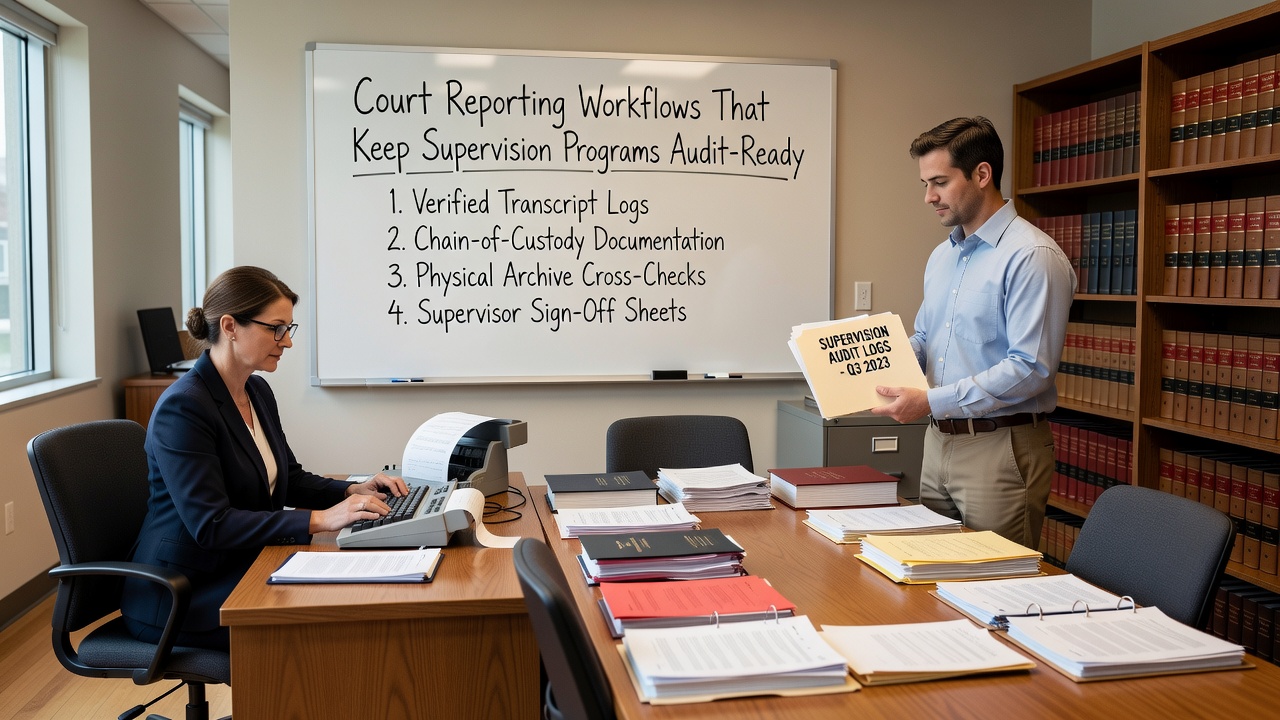
Managing court reporting workflows for supervision programs is one of the most demanding parts of running a regulated agency. Between documenting client contacts, tracking attendance, submitting compliance reports, and maintaining defensible records, the administrative load can quickly overwhelm even experienced staff. When these workflows are inconsistent or manual, gaps appear — and gaps create risk during audits, contract monitoring reviews, and court proceedings.
This guide covers practical best practices for building reliable documentation and reporting workflows, reducing administrative bottlenecks, and keeping your program files complete and consistent at every stage of service delivery.
Why Documentation Workflows Break Down
Most documentation problems in supervised programs are not caused by negligence. They are caused by unclear processes, inconsistent templates, and staff working in silos. When different team members document the same type of contact in different ways, records become hard to review and even harder to defend.
Common documentation breakdowns include:
- Progress notes written days after the session, creating gaps between what happened and what was recorded
- Attendance records stored separately from case notes, making it difficult to verify participation
- Missing signatures or required forms that are not caught until a file review or audit
- Billing entries that do not match the corresponding service documentation
- Intake records that are incomplete because no standardized checklist exists at onboarding
The root cause in most cases is the same: there is no single, consistent workflow that staff follow from intake through discharge.
Building a Reliable Workflow From Intake to Discharge
A strong documentation workflow follows the client lifecycle and has clearly defined steps at each stage. This makes it easier to train staff, catch errors early, and maintain files that are complete and defensible.
Intake Documentation
At intake, every file should include a standardized set of required documents before services begin. This typically includes:
- Signed consent and release forms
- Referral source documentation from the court, probation office, or referring agency
- Initial assessment or screening notes
- Program orientation acknowledgment
Using a consistent intake checklist — whether digital or physical — prevents important documents from being overlooked during a busy onboarding period.
Ongoing Service Documentation
During active enrollment, same-day documentation is the most reliable standard. Notes written immediately after a session are more accurate, more defensible, and less likely to create timeline discrepancies during an audit. A practical approach includes:
- Documenting attendance and participation at the time of each session
- Matching progress notes to the date and type of service delivered
- Flagging missed appointments or required contacts the same day they occur, rather than at end of month
- Tracking required forms and signatures on a rolling basis rather than reviewing everything at once
Discharge and Record Closure
File closure is where documentation gaps are most often discovered — after the fact. A discharge checklist should confirm that all required documents are present, all outstanding signatures are collected, and the final report to the court or referral partner is complete before the file is closed.
How to Catch Gaps Before an Audit Finds Them
The most effective strategy for staying audit-ready is conducting regular internal file reviews rather than waiting for an external review to surface problems. Weekly or biweekly caseload reviews help staff catch missing documentation while there is still time to address it.
A practical internal review checklist for active caseloads might include:
- Are all client contacts documented with dates, times, and service type?
- Do attendance records match session notes?
- Are required progress notes completed within the agency’s defined timeframe?
- Are all required signatures collected and stored in the file?
- Do billing records align with documented services?
- Are there any overdue contacts or missed follow-ups that need action?
End-of-month case reviews add a second layer of quality control. These reviews catch billing discrepancies, identify files with outstanding items, and ensure that any reports due to courts or probation partners are accurate before they are submitted.
Aligning Billing Records With Service Documentation
One of the most common compliance vulnerabilities in regulated programs is a mismatch between billing entries and service records. If a billing claim references a service that is not documented — or is documented differently — it creates problems during audits and contract monitoring.
To reduce billing and paperwork bottlenecks:
- Require that documentation is completed before billing is submitted for a given service date
- Use consistent service codes or categories across both documentation templates and billing records
- Review billing against case notes monthly to identify discrepancies before they are flagged externally
- Train staff on what constitutes a billable, documented service so entries are consistent across the team
Agencies that use documentation tools for supervision agencies can often automate the connection between service records and billing entries, which significantly reduces manual reconciliation work.
Standardizing Records Across Staff and Locations
Consistency is the foundation of defensible records. When every staff member uses the same templates, the same terminology, and the same documentation standards, records are easier to review internally and easier to present to courts, probation offices, and contract monitors.
Practical steps for standardizing records include:
- Develop and distribute approved templates for progress notes, contact logs, and court reports
- Train all staff on documentation standards at onboarding and during periodic refreshers
- Designate a documentation lead or compliance coordinator who reviews files and reinforces consistent practices
- Store all records in a centralized location so there is one source of truth for each client file, regardless of which staff member manages the case
For programs operating across multiple locations, centralized record storage is especially important. Agencies using software for offender treatment providers often rely on shared platforms that allow supervisors to review files, flag issues, and generate reports without physically accessing each site.
What Makes a Record Defensible During Compliance Review
A defensible record is one that can stand on its own if reviewed without additional context. It answers the basic questions: what happened, when, who was involved, and what was the outcome or next step.
Key elements of a defensible record include:
- Specific dates and times for all documented contacts and services
- Clear identification of the staff member who delivered the service or made the entry
- Objective language that describes observable behavior rather than subjective interpretations
- Consistency between the record and any related reports submitted to courts or referral partners
- A complete chain of documentation from intake through discharge with no unexplained gaps
Record retention policies also matter. Files should be retained for the period required by your program’s governing contract, state regulations, or court requirements — and staff should know those requirements before archiving or destroying records.
Takeaway
Strong court reporting workflows for supervision programs are not built on heroic individual effort — they are built on clear processes, consistent templates, and regular internal review. When agencies standardize their documentation practices from intake to discharge, align billing with service records, and conduct proactive file reviews, they reduce administrative burden and remain far better prepared for audits, contract monitoring, and court reporting requirements.
Modern software tools make this significantly more manageable by centralizing records, automating routine checks, and giving supervisors real-time visibility into caseload status and file completeness. The result is less time spent on paperwork cleanup and more time focused on delivering services.
Ready to simplify your agency’s documentation and reporting workflows? Explore how purpose-built administrative tools can help your team stay organized, compliant, and audit-ready — without adding to your staff’s workload.