
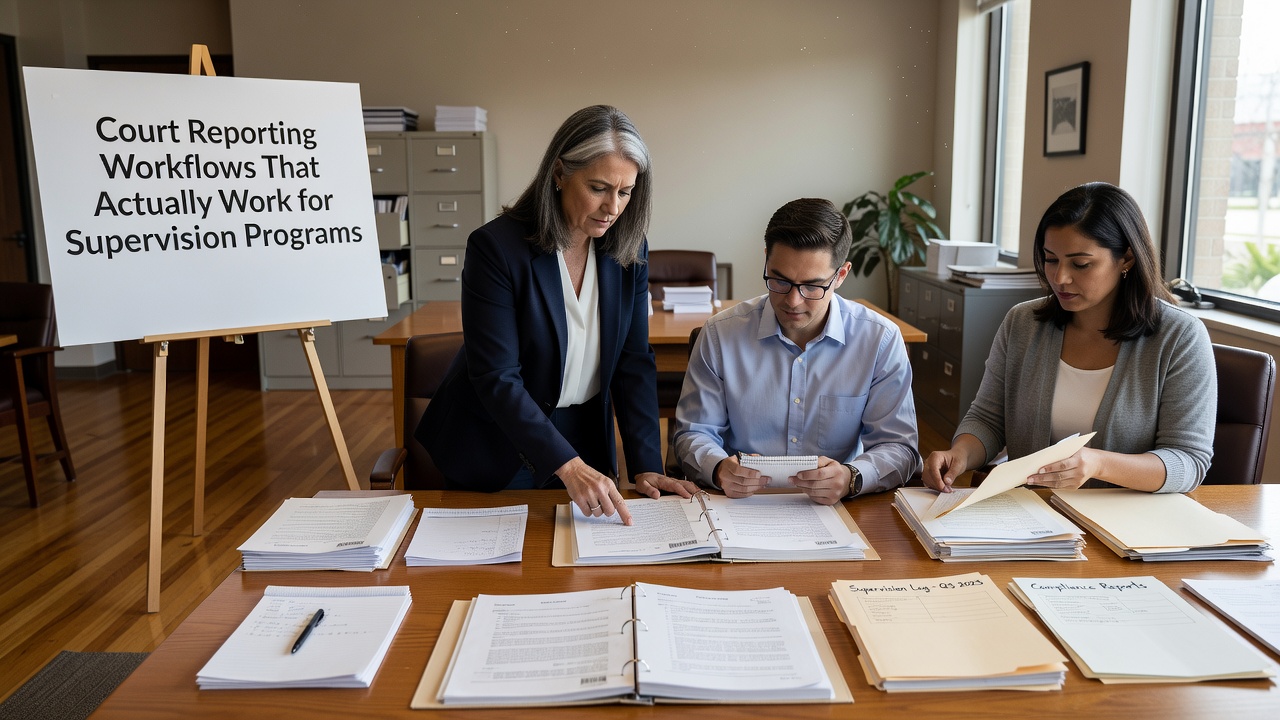
Managing court reporting workflows for supervision programs is one of the most operationally demanding responsibilities in regulated treatment and supervision environments. When reporting is inconsistent, documentation is incomplete, or billing records don’t align with service notes, agencies face audit findings, stakeholder mistrust, and staff burnout. A well-designed workflow doesn’t eliminate complexity — it makes complexity manageable.
This guide breaks down practical strategies for building reporting and documentation workflows that keep your agency accurate, efficient, and audit-ready year-round.
Why Ad-Hoc Reporting Creates More Work, Not Less
Many agencies fall into a pattern of ad-hoc reporting: pulling records on demand, assembling reports at the last minute, and relying on one or two staff members who know where everything lives. It feels like it works — until it doesn’t.
Compared to standardized reporting workflows, ad-hoc approaches tend to produce:
- More late submissions due to unclear ownership and no set schedule
- Higher error rates from rushed review or missing source documents
- Increased staff stress concentrated on a small number of people
- Inconsistent records that raise questions during audits
A reliable reporting workflow has four core elements: a defined submission schedule, a review step before reports leave the agency, a submission record confirming delivery, and a documented correction process for errors. These aren’t complicated — but they need to be written down and followed consistently.
Sample Report Routing Map
A simple routing map clarifies who does what and when:
- Staff member completes session notes and attendance logs within 24 hours
- Supervisor reviews for completeness and accuracy before the weekly deadline
- Designated coordinator compiles and submits reports to courts or referring agencies
- Office administrator logs submission date, method, and recipient
- Coordinator tracks any corrections and documents follow-up
When everyone knows their role, reports move faster and with fewer errors.
Building Documentation That Holds Up Under Review
Audit-ready documentation doesn’t happen the week before an audit. It’s the result of consistent daily practices that keep files complete, accurate, and organized at all times.
Audit-ready means:
- Every client file contains required intake documents, signed agreements, legal referral paperwork, and current treatment plans
- Session notes are completed same-day or within the agency’s policy window
- Billed services match documented services — no gaps, no mismatches
- Any corrections are dated, initialed, and explained (never overwritten or deleted)
- Files follow a consistent format across all staff
One of the most common audit findings is incomplete intake packets. Missing court referral documents, absent billing authorizations, or unsigned enrollment agreements are easy to overlook during onboarding — and costly to explain during a review.
A Practical Intake Checklist
A standardized intake packet for every new client should include:
- Government-issued ID verification
- Legal referral or court order documentation
- Signed enrollment agreement
- Assessment results or screening tools
- Releases of information (ROIs) for all relevant parties
- Billing authorization
When intake is standardized, staff don’t have to guess what’s needed — and supervisors can verify completeness with a quick file check.
Compliance Tracking That Supports Fair Decision-Making
Compliance tracking in supervision programs goes beyond attendance logs. It includes documenting missed sessions, applied sanctions, earned incentives, and phase progression — all in a format that courts and referral sources can rely on.
Inconsistent data entry is a recurring problem. When one staff member records a missed session as “excused” and another records it as “absent,” the same behavior produces different compliance outcomes for different clients. Over time, this creates disparities that are difficult to explain and defend.
Clear written criteria for compliance categories — paired with consistent data entry habits — support:
- Fair treatment across all clients
- Accurate court updates with data that matches internal records
- Stronger audit outcomes when compliance logs are reviewed against case notes
Programs operating within adult treatment court frameworks are often evaluated on documentation quality as a core performance element. Standardized compliance logs directly support those expectations.
Aligning Billing Records With Service Documentation
One of the higher-risk areas for supervision agencies is the gap between what was billed and what was documented. When billed services don’t match session notes, sign-in sheets, or treatment plans, agencies face compliance exposure — even when the service was genuinely delivered.
Common billing documentation problems include:
- Duplicate billing for the same service on the same date
- Missing documentation for billed sessions
- Mis-coded services that don’t match the actual service type in the clinical record
A simple reconciliation process helps: periodically cross-check billed codes against documented services. This doesn’t need to be a full audit — a monthly sample review of a set number of files can catch errors before they accumulate.
Agencies using documentation tools for supervision agencies can often automate parts of this cross-check, reducing the manual effort required and flagging mismatches before billing is submitted.
Reducing Bottlenecks in Reporting and Paperwork
Many agencies have a reporting bottleneck problem without recognizing it as a workflow problem. Common signs include:
- Paper sign-in sheets that have to be manually re-entered into a separate system
- One staff member responsible for assembling all reports
- Last-minute report creation the morning something is due
- Staff spending significant time on data re-entry instead of client-facing work
Straightforward fixes don’t require a technology overhaul:
- Batch documentation tasks by scheduling standing weekly time for staff to complete and review records
- Standardize forms so all staff use the same templates regardless of caseload
- Define clear hand-offs so no single person is the only one who knows how something works
- Create pre-submission checklists that verify dates, names, case numbers, signatures, and attachments before reports go out
For agencies managing higher volumes, purpose-built compliance tracking for regulated programs can centralize documentation, reduce manual re-entry, and make submission records easier to maintain.
Takeaway
Effective court reporting workflows for supervision programs aren’t built on extra effort — they’re built on consistent processes, clear roles, and standardized documentation habits. Agencies that maintain audit-ready files year-round, align billing with service records, and use defined reporting workflows experience fewer last-minute crises, fewer errors, and stronger outcomes during reviews.
Modern software tools can reinforce these practices by centralizing records, automating routine checks, and reducing the manual work that creates bottlenecks. But the foundation is always the same: clear policies, trained staff, and workflows that everyone follows consistently.
If your agency is reviewing its documentation and reporting processes, start with the workflow gaps that create the most friction — and build from there.