
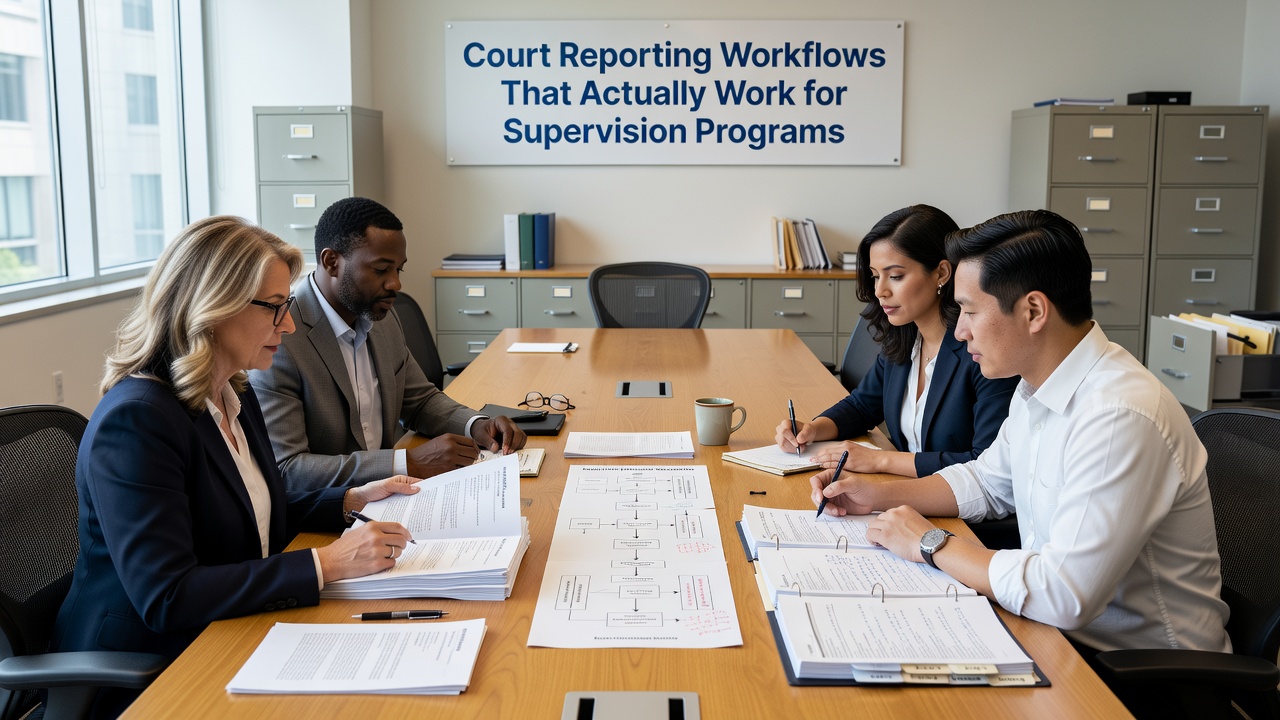
For agencies managing regulated supervision programs, court reporting workflows are rarely just a paperwork exercise. They are the operational backbone that connects clinical documentation, billing, compliance tracking, and court submissions into a single, accountable process. When those workflows are unclear or inconsistently followed, the result is rework, missed deadlines, and documentation gaps that create real risk during audits or reporting reviews.
The good news is that most reporting problems are preventable. The agencies that handle reporting well are not doing anything extraordinary. They have simply built structured, repeatable workflows that their teams can follow consistently, even when caseloads are high.
Why Reporting Workflows Break Down
Most reporting problems do not start at the point of submission. They start much earlier, in the daily documentation habits and data management practices that either support or undermine the reporting process.
Some of the most common breakdown points include:
- Late or incomplete session notes that are not finalized within 24 to 48 hours of a session, leaving gaps when a report is due
- Inconsistent attendance records that do not match billing data, requiring time-consuming reconciliation before any report can go out
- Missing corrections logs so there is no clear record of what was changed in a client file, when, by whom, and why
- Unclear ownership over who drafts, reviews, approves, and submits each report
- No submission log to confirm what was sent, to whom, by what method, and when confirmation was received
Each of these is a workflow problem, not a technology problem. But the right software tools can make well-designed workflows much easier to follow.
Building a Reporting Workflow Your Team Will Follow
A good reporting workflow does not depend on people remembering to do the right thing. It builds structure into the process so that required steps are visible, assigned, and trackable.
Set Internal Deadlines Ahead of External Due Dates
One of the most practical improvements an agency can make is creating internal submission deadlines that sit 5 to 7 business days before external court or agency due dates. This buffer gives supervisors time to review drafts, catch missing documentation, and make corrections without rushing.
Agencies that skip this step often find themselves submitting reports that contain errors or missing attachments, or asking for extensions that could have been avoided.
Assign Clear Ownership for Every Step
Every report should have a defined owner at each stage: who is responsible for drafting, who reviews, who approves, and who submits. When ownership is ambiguous, tasks fall through the cracks. This is especially true in agencies where clinical and administrative staff share responsibility for different parts of the same submission.
Use a Submission Checklist Before Every Report Goes Out
A simple checklist reviewed before each submission can prevent a significant share of errors. The checklist should confirm that required elements are present, that attendance data matches billing records, that any sanctions or program changes are documented, and that client signatures are in place where required.
A pre-submission checklist does not need to be complex. It just needs to be used consistently.
Aligning Documentation and Billing to Reduce Rework
One of the more persistent sources of administrative burden in supervision programs is the disconnect between clinical documentation and billing workflows. When these two functions operate in silos, problems accumulate.
Billing submitted before documentation of makeup sessions or program changes is complete creates denials and rework. Attendance data maintained in separate systems by clinical and billing teams leads to inconsistencies that take time to resolve. Duplicate data entry increases the risk of errors and delays.
The practical fix is to establish a single source of attendance data that both clinical and billing staff work from. Weekly reconciliation of that data, before billing is submitted, catches discrepancies early when they are easy to resolve rather than later when they require formal corrections.
Using documentation tools for supervision agencies that keep clinical notes, attendance records, and billing data connected reduces the back-and-forth between departments and makes the entire reporting cycle faster and more accurate.
Staying Audit-Ready Without Last-Minute Scrambling
Audit readiness is not something that can be built in the week before a review. It is the result of consistent documentation habits maintained across every case, every month.
Agencies that stay audit-ready year-round tend to share a few common practices:
- Standardized note templates aligned to accreditation or regulatory requirements, so documentation is consistently structured regardless of which staff member is writing
- Monthly file reviews using structured checklists that cover session note timeliness, attendance versus billing, client signatures, sanctions documentation, and corrections logs
- Ongoing chart review tools built into their software, rather than one-time exports assembled when an audit is scheduled
- A team culture that treats documentation accuracy as an ongoing responsibility, not a pre-audit task
Monthly file reviews do not need to cover every case. For agencies with high caseloads, a risk-based sampling approach, reviewing a structured subset of files each month, can provide meaningful oversight without overwhelming supervisors.
What a Monthly File Review Should Cover
A practical monthly file review checklist for supervision programs should include:
- Session notes: Are all notes completed and finalized within the required timeframe?
- Attendance records: Do attendance logs match billing records for the same period?
- Signatures: Are required client signatures present and dated?
- Sanctions and program changes: Are all sanctions, missed sessions, and level-of-care changes documented in real time?
- Progress reports: Are scheduled progress reports complete and on file?
- Corrections log: Is there a clear record of any changes made to documentation, including who made them and when?
This kind of structured review, done consistently, keeps files current and makes formal audits far less stressful.
Logging Submissions and Maintaining a Paper Trail
One step that agencies frequently overlook is maintaining a submission log for every report sent to a court, supervising agency, or referral source. The log should record the date of submission, the method used, the recipient, and any confirmation received.
Reports should also be filed immediately in the client record upon submission. This practice ensures that anyone reviewing the file later, whether a supervisor, auditor, or new staff member, can see exactly what was sent and when without having to search through email threads or external folders.
For agencies using compliance tracking for regulated programs, automated logging and file attachment features can handle this step without adding to staff workload.
Takeaway
Most reporting and compliance challenges in supervision programs come down to workflow gaps, not isolated mistakes. When agencies build structured, clearly assigned, and consistently followed reporting workflows, the operational burden decreases and documentation quality improves. Setting internal deadlines, reconciling attendance and billing data weekly, using pre-submission checklists, and running monthly file reviews are practical habits that reduce rework and keep programs audit-ready year-round. Modern software tools can support and reinforce these workflows, making it easier for teams to stay consistent even when caseloads are high.
Want to see how software can support your agency’s reporting and compliance workflows? Schedule a demo to learn how purpose-built tools can reduce administrative burden and help your team stay documentation-ready every day.