
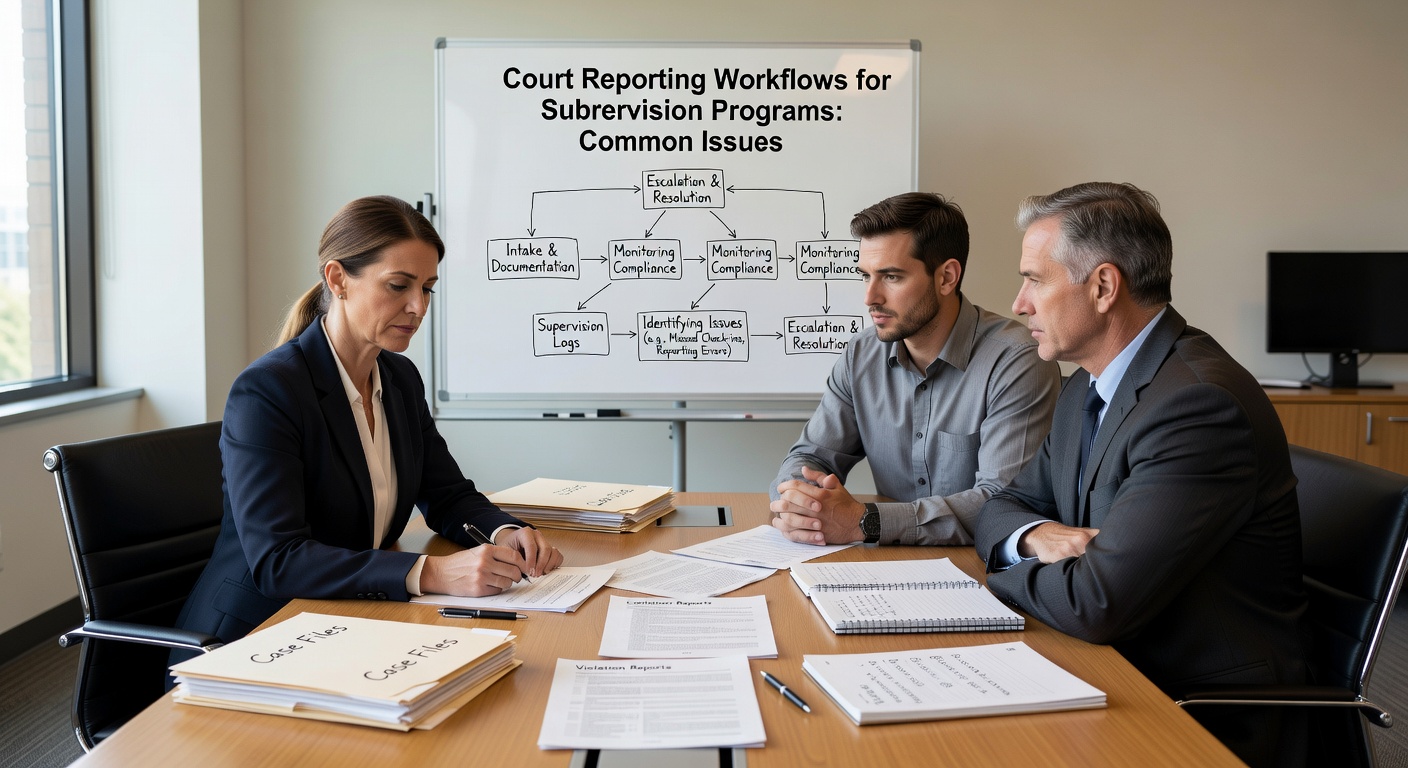
Effective court reporting workflows for supervision programs require systematic approaches to documentation, compliance tracking, and administrative coordination. Many agencies struggle with manual processes that create bottlenecks, increase errors, and consume valuable staff time that could be better spent on client services.
Documentation Standardization Challenges
Inconsistent documentation formatting creates significant problems for supervision agencies. Staff often use different templates or note-taking styles, making it difficult to locate critical information during audits or court proceedings. Missing signatures, timestamps, or incomplete session records can trigger compliance violations even when services were properly delivered.
Key documentation issues include:
• Varying note formats across staff members • Incomplete attendance tracking • Missing behavioral observations or intervention details • Inconsistent use of required assessment tools • Delayed entry of session summaries
Standardized templates using formats like SOAP (Subjective, Objective, Assessment, Plan) or DAP (Data, Assessment, Plan) help ensure consistent documentation across all staff members. Electronic forms with required fields prevent incomplete records from being submitted.
Administrative Workflow Bottlenecks
Manual data entry creates multiple opportunities for errors and delays. Staff frequently duplicate information across different systems, risking transcription mistakes that can delay communications or trigger compliance issues. Paper-based processes limit real-time access to participant information, especially problematic when multiple agencies need current status updates.
Common administrative challenges include:
• Duplicate data entry across multiple systems • Lost or misfiled paperwork • Delayed report generation for court hearings • Difficulty tracking participant progress across programs • Time-consuming preparation for compliance audits
Digital Workflow Solutions
Modern software platforms address these bottlenecks through single-entry systems where information entered once populates all necessary reports and communications. Automated validation ensures required fields are completed before records can be saved.
Compliance Tracking Complexities
Supervision agencies must manage multiple reporting schedules, court dates, drug testing requirements, and program milestones simultaneously. Manual tracking methods often fail to flag upcoming deadlines or identify participants who are falling behind in their requirements.
Missed compliance deadlines can result in:
• Court sanctions against participants • Program funding penalties • Increased liability for agencies • Additional administrative work to resolve violations
Automated compliance monitoring systems provide real-time dashboards showing participant status across all requirements. These platforms generate alerts for upcoming deadlines and flag potential violations before they become serious issues.
Risk Management Through Technology
Compliance tracking software helps agencies maintain audit readiness by automatically generating required reports and maintaining detailed activity logs. This documentation proves invaluable during regulatory reviews or court inquiries.
Inter-Agency Coordination Difficulties
Supervision programs often involve multiple stakeholders including courts, probation departments, treatment providers, and testing facilities. Incompatible systems and varying data formats create communication gaps that can delay critical information sharing.
Coordination challenges include:
• Different reporting requirements across agencies • Privacy regulation conflicts (HIPAA, FERPA) • Delayed information sharing between providers • Duplicated assessments and intake processes • Difficulty accessing participant history across programs
Integrated Platform Benefits
Centralized platforms with proper access controls enable secure information sharing while maintaining required privacy protections. Integration capabilities allow agencies to share relevant data without compromising confidentiality or duplicating efforts.
Billing and Revenue Cycle Issues
Manual billing processes often result in delayed payments, coding errors, and missed billable services. Inconsistent documentation makes it difficult to justify services provided, leading to denied claims and revenue losses.
Revenue cycle problems include:
• Delayed submission of billing documentation • Inconsistent service coding • Missing required authorizations • Difficulty tracking billable vs. non-billable activities • Time-consuming insurance verification processes
Automated billing integration captures billable services in real-time and ensures proper coding based on services documented. This reduces claim denials and accelerates payment processing.
Technology Implementation Best Practices
Successful workflow improvement requires careful planning and staff training. Start with the most problematic areas and gradually expand automation to other processes. Staff buy-in is critical for successful technology adoption.
Implementation considerations:
• Identify current workflow pain points • Prioritize solutions based on compliance risk and time savings • Ensure adequate staff training on new systems • Maintain backup procedures during transition periods • Monitor system performance and gather user feedback
Agencies should look for compliance tracking for regulated programs that integrate seamlessly with existing court reporting requirements and provide comprehensive audit trails.
Takeaway
Streamlined court reporting workflows for supervision programs reduce administrative burden while improving compliance outcomes. Modern software platforms address common challenges through standardized documentation, automated compliance tracking, and integrated inter-agency communication. By implementing these technological solutions, agencies can redirect staff time from administrative tasks to direct client services while maintaining the detailed documentation required for regulatory compliance and audit readiness.