
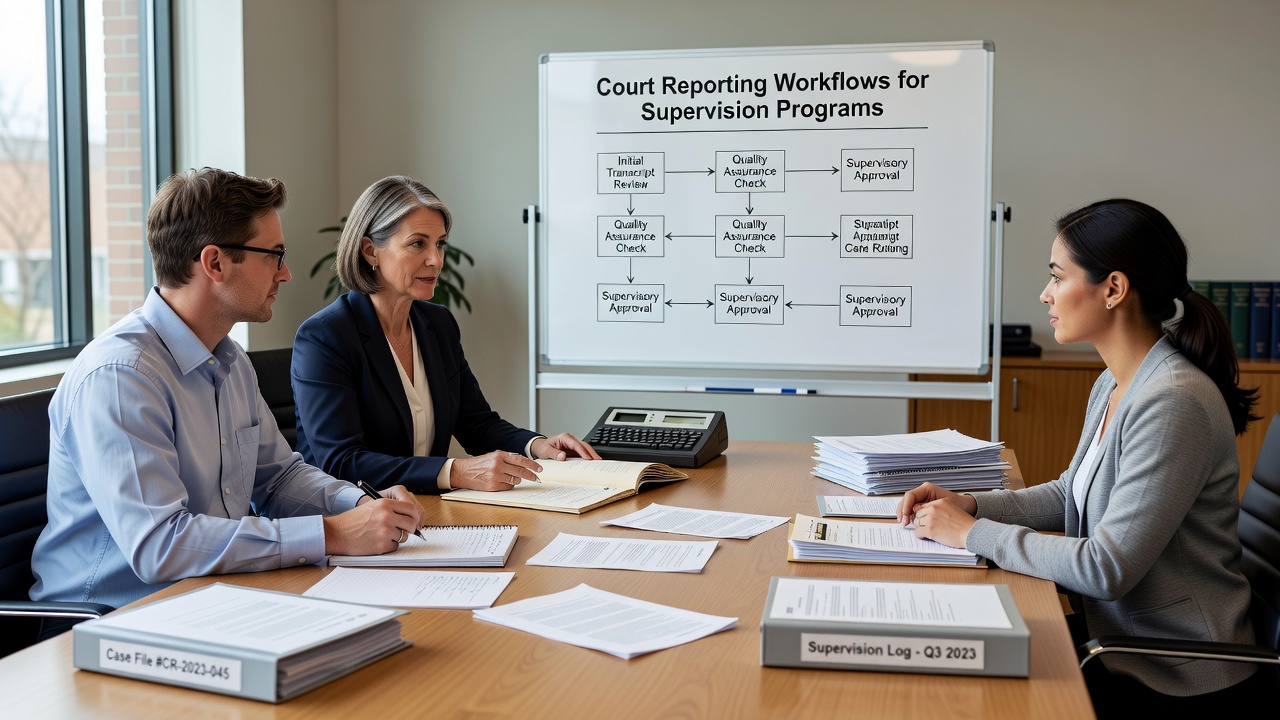
Agencies managing supervision-based programs often struggle with one of the same core challenges: court reporting workflows for supervision programs that are inconsistent, time-consuming, and difficult to maintain across a caseload. When documentation and reporting aren’t standardized, the downstream effects show up fast — missed deadlines, incomplete files, billing denials, and findings during audits. The good news is that most of these problems are preventable with the right workflows, templates, and tools in place.
Why Documentation Errors Create Compliance Risk
Many compliance problems in supervised treatment settings don’t start with bad intentions — they start with incomplete intake records, inconsistent note formats, or missing signatures on consent forms. These small gaps compound over time and become significant findings during licensing reviews or court audits.
Common documentation mistakes that create real risk include:
- Missing referral details or court conditions at intake, which creates gaps in the client’s official record
- Incomplete progress notes — no clinical rationale, missing timestamps, or vague descriptions of interventions
- Undocumented consent or disclosure decisions, especially when sharing information with probation officers or courts under 42 CFR Part 2 or HIPAA
- Inconsistent note formats, such as switching between SOAP, DAP, and free-text without a defined standard
When staff are writing notes in whatever format feels familiar, and intake paperwork varies from case to case, it becomes nearly impossible to demonstrate compliance consistently. Standardized templates and required fields solve this problem at the source.
Building a Standardized Intake Checklist
A strong intake process is the foundation of every well-documented case. As one practical principle puts it: *if it’s not captured at intake, you’ll be chasing paperwork for the rest of the case.*
For supervision-linked programs, an effective intake checklist should include:
- Court orders, referral forms, and supervision conditions (probation or parole terms)
- Releases of information covering both HIPAA and 42 CFR Part 2 considerations for justice partners
- Payment agreements and funding source documentation, including identity verification
- Baseline risk and needs assessments tied to program eligibility criteria
When these elements are embedded as required fields in your intake workflow — rather than left to individual staff judgment — completeness becomes the default, not the exception.
Improving Court Reporting Workflows Across Your Caseload
One of the highest-burden tasks for supervision program staff is generating accurate, timely reports for courts and probation offices. Most agencies handle this reactively, producing one-off reports as requests come in. That approach is slow, error-prone, and hard to track.
A more sustainable approach builds structure into the reporting process itself:
Use Standardized Report Templates
Creating templates aligned with local court expectations and probation standards eliminates the need to rebuild each report from scratch. Staff spend less time formatting and more time ensuring accuracy.
Batch and Schedule Reports
Instead of generating reports one at a time, agencies can use scheduled or batch reporting to produce multiple reports at defined intervals. This reduces interruptions and ensures no client falls through the cracks.
Maintain a Reporting Calendar
A shared reporting calendar that tracks deadlines across all clients and referral sources gives coordinators visibility into what’s due and when. This simple tool significantly reduces last-minute scrambles.
Document What Was Reported and When
Logging each report submission — including what was sent, when, and to whom — creates an audit trail that protects the agency during reviews or disputes. Without this, agencies are often left relying on memory or email searches.
Compliance tracking for regulated programs that integrates documentation with reporting workflows makes these steps much easier to maintain consistently.
Tracking Compliance Metrics and Staying Audit-Ready
Compliance tracking goes beyond keeping files organized. For supervision programs, it means actively monitoring whether obligations are being met — and having the records to prove it.
Client-Level Compliance Metrics
Programs should track:
- Attendance and participation rates per client
- Noncompliance events and how they were documented and reported
- Program completion status against court-ordered timelines
Organizational Compliance Monitoring
At the agency level, useful compliance tracking includes:
- Mapping internal controls to specific requirements — licensing, grant rules, court standards
- Using simple status categories like *Applicable – Covered* or *Not Covered* to visualize gaps quickly
- Monitoring billing submission and denial rates as both a revenue and compliance indicator
Audit readiness shouldn’t be something that only happens when a reviewer is scheduled. Agencies that conduct regular internal chart reviews, billing audits, and documentation spot checks on a defined calendar are far better positioned when external reviews occur. Pairing this with a clear record retention policy — aligned to state licensing, Medicaid, and grant requirements — ensures that records are available when needed and destroyed appropriately when retention periods end.
For programs working with justice-involved populations, documentation tools for supervision agencies that support structured note formats, required fields, and audit-ready record management can significantly reduce the manual effort involved in maintaining this level of readiness.
Embedding Compliance Into Daily Operations
The agencies that stay consistently audit-ready aren’t doing anything dramatically different — they’ve made compliance part of how daily work gets done, not a separate project that competes with it.
Practical ways to embed compliance into daily operations include:
- Onboarding and orientation that explicitly covers documentation standards and supervision-specific policies from day one
- Brief daily huddles to surface documentation issues, recent incidents, or anything affecting supervised clients before it becomes a problem
- Including documentation quality as a metric in staff performance evaluations, not just clinical outcomes
- Centralizing SOPs and policies in a single accessible location rather than scattered across shared drives or printed binders
- Role-based training so clinicians, front desk staff, billing coordinators, and case managers each understand the compliance expectations relevant to their work
When staff understand why compliance practices matter — not just what the rules are — it becomes easier to maintain consistently, even during high caseload periods.
Takeaway
Most reporting and documentation challenges in supervision programs aren’t caused by disorganized staff — they’re caused by workflows that weren’t designed for this environment in the first place. When agencies invest in structured intake checklists, standardized note formats, scheduled reporting processes, and internal compliance calendars, they reduce administrative burden while improving the accuracy and completeness of every record they produce. Modern software tools built for these environments make it practical to maintain these standards across a full caseload without adding hours of manual work. The result is a program that’s better prepared for audits, better positioned for billing accuracy, and more consistent in meeting the reporting obligations that courts and licensing bodies require.
Ready to simplify your documentation and reporting workflows? Explore how purpose-built tools can help your program stay compliant, reduce paperwork burden, and stay audit-ready year-round.