
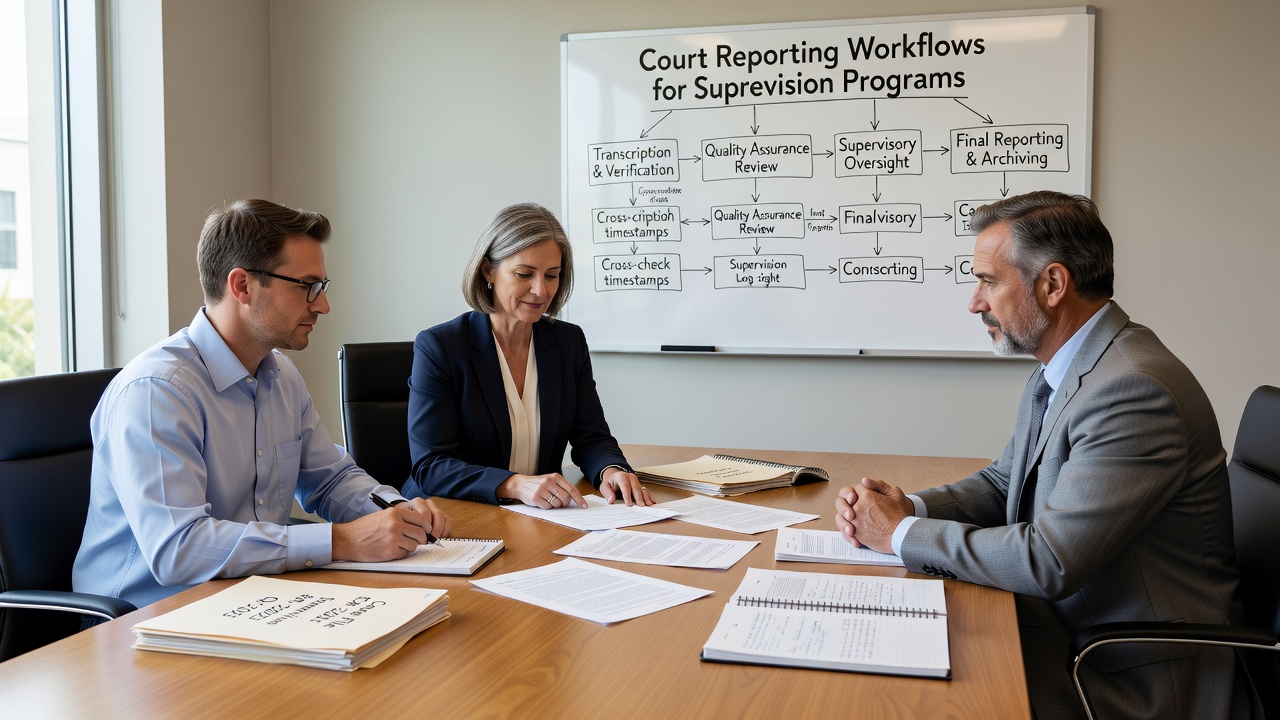
Strong court reporting workflows for supervision programs are one of the most practical ways agencies reduce administrative burden, catch documentation errors before they become problems, and stay prepared when audits or court reviews arrive. Yet for many programs, reporting remains a patchwork of manual steps, inconsistent records, and last-minute scrambles. This guide covers the key workflow and documentation practices that help regulated supervision and treatment programs run more efficiently.
Why Reporting Workflows Break Down
Most documentation problems in supervision programs don’t start with bad intentions. They start with unclear processes. When staff don’t have defined roles, standard templates, or consistent compliance statuses, small inconsistencies compound over time into serious gaps.
Common breakdowns include:
- Case notes that aren’t clearly tied to a court order or contract requirement, making it hard to prove compliance during a review
- Inconsistent use of compliance statuses across staff or locations, such as one case manager marking a participant “pending” while another marks the same situation “non-compliant”
- Late entries and backdated notes with no documented explanation for the delay
- Missing corrective action records when internal reviews find problems
- Dual systems — paper and digital — that create gaps and version conflicts
These aren’t just documentation quality issues. They affect billing, court reporting, and licensing audits in real, measurable ways.
Building Repeatable Court Reporting Workflows
The goal of a well-designed reporting workflow is that any qualified staff member can complete the same task the same way, every time. This is especially important for high-stakes outputs like court progress reports, case closures, and status change notifications.
Define Who Does What
Role clarity is foundational. For every reporting task, your workflow should document:
- Who prepares the report or record
- Who reviews it before submission
- Who submits it and through what channel
- How each step is documented in case of a future audit
Without this structure, it’s easy for submissions to go out unreviewed or for accountability to fall through when staff turn over.
Real-Time vs. Batched Documentation
Not every record needs to be entered in real time, but some do. A practical rule of thumb:
- Incidents, violations, and safety events should be entered immediately
- Attendance and session notes can often be batched daily or at the end of each business day
- Billing records should be reconciled against documentation at least weekly to catch mismatches before they become denied claims
Building these timing rules into your workflow removes the guesswork and creates a natural audit trail.
Compliance Tracking That Works in Practice
Compliance tracking is most reliable when it’s standardized across your entire program, not left to individual interpretation.
Start by defining a standard set of compliance statuses — for example: compliant, non-compliant, pending, and partial — and train all staff to apply them consistently. Document what each status means and when it should be used. This single step can dramatically reduce confusion during audits or court reviews.
For participants who fall out of compliance, build an escalation checklist so staff responses are consistent regardless of who is handling the case. Each checklist entry should capture:
- The nature of the non-compliance
- The date it was identified
- The follow-up action taken
- The outcome and resolution date
This kind of structured tracking demonstrates to courts and funders that your program responds to issues promptly and systematically.
Risk-Based Monitoring
Small agencies in particular often struggle to review every case equally. A risk-based monitoring approach is more realistic and more effective:
- Conduct weekly reviews of high-risk cases
- Do monthly sampling of the general caseload
- Reserve quarterly deep reviews for billing, documentation accuracy, and policy compliance
This approach focuses staff attention where it matters most without requiring additional headcount.
Aligning Documentation With Billing
One of the most common — and costly — workflow failures in regulated treatment programs is the misalignment between clinical documentation and billing records. When a session note doesn’t match what was billed, agencies face denied claims, additional reconciliation work, and potential compliance exposure.
The fix isn’t just better billing processes. It’s building documentation workflows where the clinical record and the billing record are generated from the same source of truth. When session documentation is complete and accurate at the point of service, billing becomes a downstream confirmation rather than a separate data-entry task.
Software tools designed for compliance tracking for regulated programs can help agencies link documentation directly to billing triggers, reducing the manual reconciliation that typically happens at month-end.
Staying Audit-Ready Through Everyday Habits
Audit readiness isn’t something you prepare for — it’s something you maintain. Agencies that handle audits well aren’t doing anything special when the auditor arrives. They’ve simply built good habits into their daily workflows.
Practical habits that build a strong audit trail:
- Tie each record to a specific obligation — a court order, contract clause, or regulatory requirement — so the connection is clear without explanation
- Use structured templates for progress notes, session summaries, and incident reports to reduce variability across staff
- Document policy acknowledgements and participant notifications so you can show that participants were informed of their obligations
- Run periodic retrieval tests — pull a random sample of records and confirm they are complete, accurate, and retrievable within a reasonable timeframe
- Maintain an audit calendar with weekly, monthly, and quarterly checkpoints for documentation, billing, and privacy reviews
For agencies providing administrative workflow tools for court ordered programs, purpose-built software can automate many of these checkpoints and flag records that are incomplete or overdue before they become audit findings.
Takeaway
Court reporting workflows for supervision programs work best when they’re built around clear roles, consistent standards, and repeatable processes — not individual effort or institutional memory. Agencies that invest in structured templates, defined compliance statuses, and aligned documentation and billing practices spend less time on administrative catch-up and more time on program delivery. Modern software tools that support these workflows can help compliance coordinators and program administrators maintain accurate records, meet reporting deadlines, and stay prepared for audits without adding staff or manual overhead.