
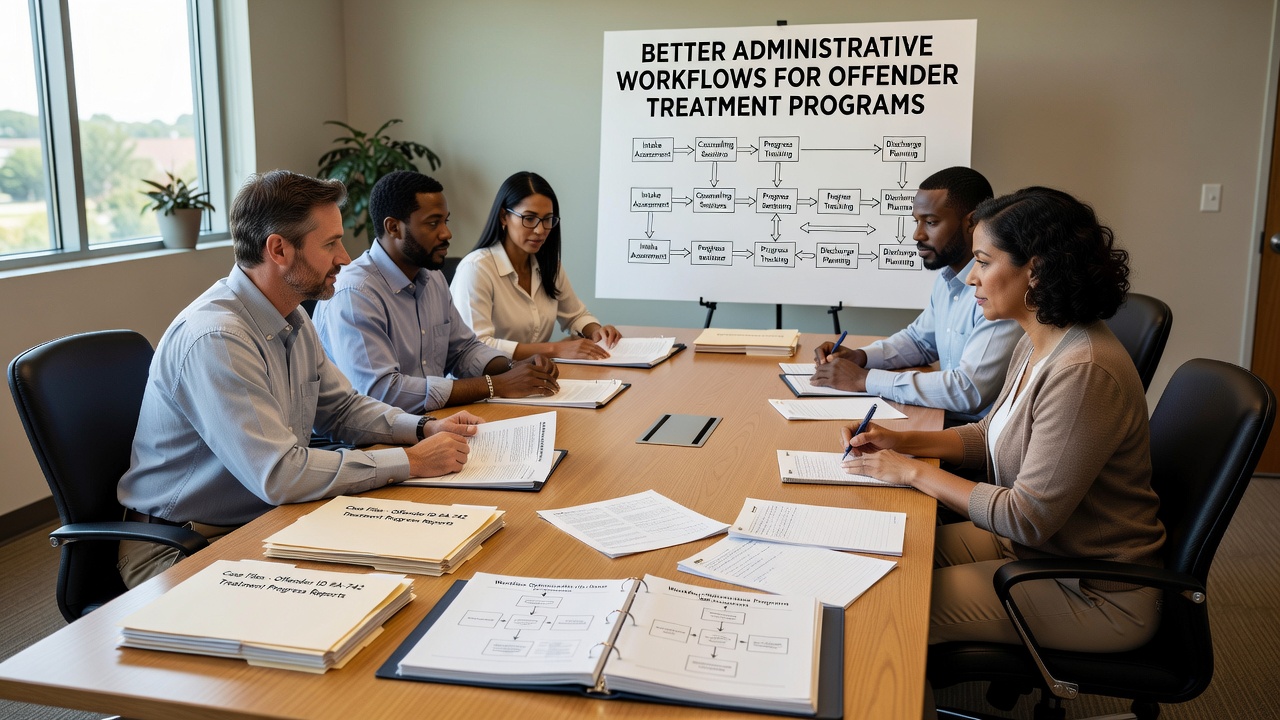
Agencies managing supervised treatment programs often carry a heavy administrative load—tracking attendance, managing case files, submitting compliance reports, and keeping billing aligned with service records. When administrative workflows for offender treatment programs are poorly designed, even well-run programs can face documentation gaps, reporting errors, and audit vulnerabilities. The good news is that most of these risks are preventable with clearer processes, defined roles, and the right tools.
Why Documentation Quality Drives Everything Else
Most compliance problems in supervised treatment programs don’t start with noncompliant clients—they start with incomplete or inconsistent documentation. A missing signature on an intake form, a session note filed two days late, or a billing entry without a corresponding service record can create serious problems during an audit or court review.
Some of the most common documentation mistakes that create audit risk include:
- Missing or unsigned intake forms, consent documents, and program agreements
- Session notes that don’t align with attendance records
- Billing entries without supporting documentation
- Court reports that contradict case notes
- Discharge paperwork filed late, leaving cases technically open
A complete client file should follow the client through every stage: intake, enrollment, active participation, and discharge. At each stage, specific forms need to be signed, dated, and tracked. Knowing what auditors expect to find—and organizing files accordingly from day one—removes the scramble that typically happens when a review is announced.
Building Consistent Documentation Standards
One of the most effective ways to reduce documentation errors is to set clear, non-negotiable standards for how and when notes are completed.
Set Documentation Windows
Progress notes should be completed within a defined window—commonly 24 hours after a session. When this window is enforced consistently, it prevents the problem of reconstructed notes, which are immediately recognizable to auditors and damage credibility.
Use Objective, Observable Language
Notes should describe what happened—attendance, participation level, behaviors observed—rather than subjective interpretations. This is especially important in programs where only compliance status is being reported to courts and probation, not detailed clinical content.
Document Corrections Properly
When a note needs to be corrected, the change should be timestamped and the reason noted. Crossing out entries without explanation or altering dates creates documentation integrity issues that are difficult to defend.
Designing Compliance Reporting Workflows That Actually Work
Many agencies treat compliance reporting as a one-time task that happens at the end of a reporting period. This approach creates bottlenecks, increases the chance of error, and puts pressure on staff to reconstruct documentation under deadline.
A better approach separates the work across roles and stages:
- Counselors complete session notes within the required window
- Admin staff reconcile attendance logs against session notes regularly—not just at month-end
- Billing staff match service records to billing entries before invoices are submitted
- A designated compliance reviewer checks that all required documentation is in place before any report goes out
Using checklists at each stage prevents last-minute reconstruction and makes it easier to catch mismatches between attendance, notes, billing, and court reports before they become reportable errors.
What Courts and Probation Officers Typically Expect
Most courts and probation officers want a clear picture of participation and compliance—not detailed clinical content. Reports should include:
- Attendance and participation summaries
- Clear completion status and whether all program requirements were met
- Documentation of problems such as missed sessions or noncompliance, and how they were addressed
Omitting required referral information, case numbers, or exception documentation (like no-shows or schedule changes) are among the most common errors that damage provider credibility with courts over time.
Staying Audit-Ready Year-Round
Audit readiness shouldn’t be a seasonal activity. Agencies that maintain continuous compliance habits are far better positioned than those that do batch reviews only when a deadline is approaching.
Practical steps for year-round audit readiness include:
- Assigning clear ownership for each compliance area so nothing falls through the cracks
- Running monthly file reviews that sample active cases and check for missing agreements, unsigned forms, and note-to-billing alignment
- Maintaining submission logs for court reports and other required documentation
- Tracking staff credentials and licenses alongside client files so everything is accessible when requested
Some agencies also benefit from running internal mock audits—simulating an external review with realistic timelines—to identify gaps and train staff on what reviewers typically focus on. This approach surfaces problems early and builds staff confidence in handling actual audit requests.
A Basic Audit Readiness Checklist
Use this as a starting point for monthly or quarterly internal reviews:
- [ ] Intake and enrollment forms are complete and signed
- [ ] Attendance records align with session notes
- [ ] Billing entries are supported by service documentation
- [ ] Court reports have been submitted and logged
- [ ] Discharge documentation is filed for closed cases
- [ ] Staff credentials are current and on file
How Software Tools Support Better Workflows
Many of the workflow problems described above are manageable through process improvement alone—but documentation tools for supervision agencies can make consistent execution significantly easier. When attendance, notes, billing, and reporting are tracked within a connected system, reconciliation becomes faster and errors are easier to catch before they leave the agency.
For agencies managing compliance tracking across multiple programs or providers, administrative workflow tools for court ordered programs can standardize how information is recorded, reduce duplicate data entry, and give supervisors real-time visibility into file completeness. Similarly, software for offender treatment providers often includes built-in report templates, attendance tracking, and billing alignment features that reduce the manual cross-checking burden on staff.
The goal isn’t to add technology for its own sake. It’s to remove the friction that causes documentation to fall behind, notes to go unsigned, and billing to drift out of sync with service records.
Takeaway
The administrative workflows that support supervised treatment programs directly affect compliance, reporting accuracy, and audit outcomes. Agencies that build documentation standards into daily practice—rather than treating compliance as a deadline-driven activity—experience fewer errors, less staff stress, and stronger relationships with courts and probation partners. Modern software tools can reinforce these habits by centralizing records, automating reconciliation steps, and keeping files consistently organized and audit-ready. The investment in better workflows pays off not just during audits, but in the quality and reliability of every report your agency submits.
—
Ready to evaluate your agency’s administrative workflows? Review your current documentation standards, reconciliation steps, and reporting processes against the checklist in this article—and consider whether your current tools are making that work easier or harder.