
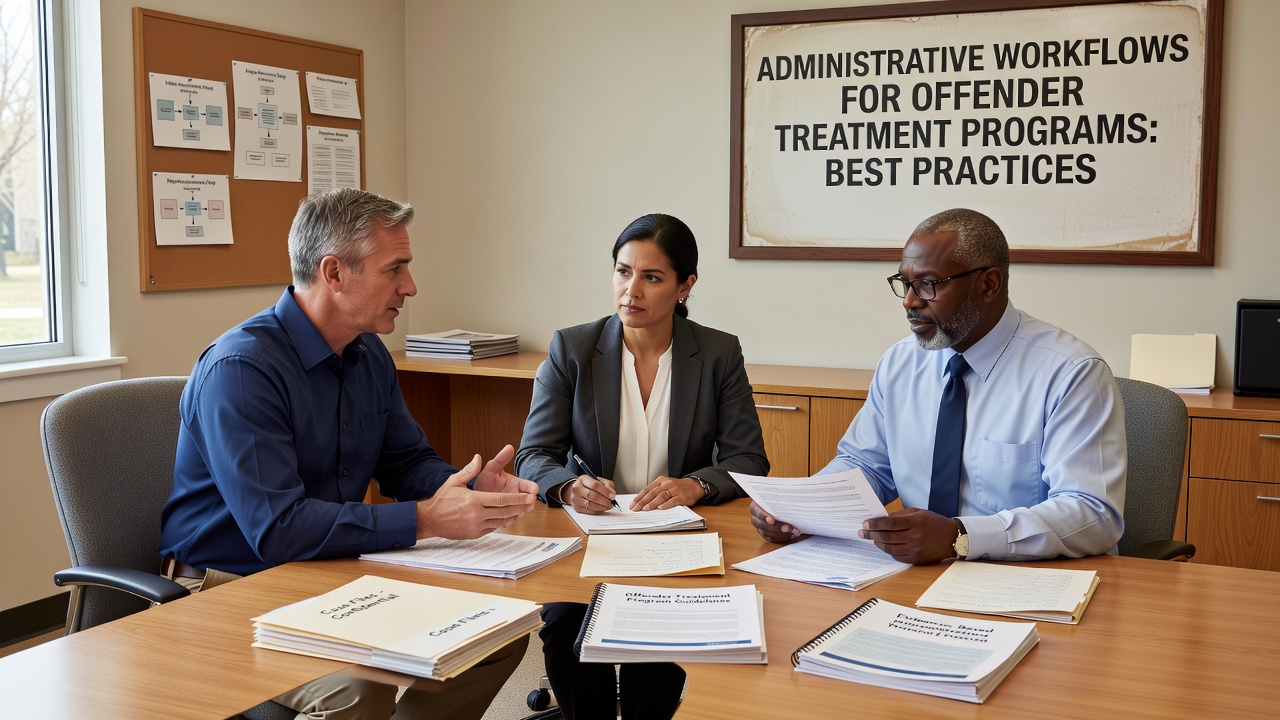
Managing administrative workflows for offender treatment programs is one of the most demanding operational challenges agencies face today. Between recurring court submissions, attendance tracking, billing reconciliation, and file compliance, the volume of documentation can quickly outpace manual systems. When workflows are inconsistent or undocumented, even well-run programs are exposed to audit risk, billing disputes, and reporting gaps. The good news is that clear processes and the right tools can significantly reduce that burden.
Why Documentation Mistakes Create Compliance Risk
Documentation errors are among the most common sources of audit findings in regulated supervision and treatment programs. Many are preventable with consistent intake procedures and standardized case note formats.
Common documentation mistakes include:
- Incomplete intake files — missing signed forms, unsigned acknowledgments, or absent authorization records at the point of enrollment
- Undocumented missed sessions — sessions that a client did not attend but were never logged as absences or exceptions
- Inconsistent case notes — notes that vary in format or detail across staff members, making review and auditing harder
- Late or missing exception documentation — waivers, payment adjustments, and non-standard arrangements that were handled but never recorded at the time they occurred
Exceptions are a particularly common source of risk. When a co-pay is waived or a session is rescheduled under unusual circumstances, that decision needs to be documented immediately — not reconstructed weeks later when an auditor asks about it.
How to Build a Reliable Compliance Calendar
Agencies managing multiple referral sources face a real coordination challenge: different courts, agencies, and jurisdictions often have different reporting deadlines, submission formats, and follow-up requirements. Without a structured compliance calendar, it is easy for a deadline to slip or for a required update to go out without proper internal review.
A practical compliance calendar should account for:
- Recurring report submission dates by referral source or supervising authority
- Internal review windows scheduled before each external deadline, so files can be checked before submission
- Acknowledgment tracking to confirm that submitted reports were received and reviewed
- Exception flags for clients whose progress, attendance, or status requires special documentation before the next report cycle
Building this calendar into your team’s standard operating rhythm — rather than treating it as a separate compliance task — makes it sustainable. When deadline tracking is embedded in the workflow, staff spend less time remembering and more time acting.
Standardizing Case Notes and Attendance Records
One of the highest-impact improvements an agency can make is standardizing how case notes are written across the entire team. When each counselor or case manager uses a different format, documentation becomes harder to audit, harder to hand off, and harder to defend if questions arise.
What standardized case notes should include
- Date, session type, and duration
- Client attendance status (present, absent, excused, unexcused)
- Summary of session content or progress toward program objectives
- Any exceptions, incidents, or deviations from the program plan
- Staff signature and credentials
The same principle applies to attendance records. Attendance and billing should reconcile on a regular cycle — ideally weekly — so that discrepancies between what was billed, what was attended, and what was waived or written off are caught early. Letting those gaps accumulate over a month or a quarter makes them much harder to resolve and creates audit exposure.
Documenting exceptions the right way
Exceptions are not problems in themselves. What creates problems is an undocumented exception. Every waiver, scheduling deviation, or non-standard arrangement should have a corresponding record that captures what happened, why the decision was made, and who authorized it. This is especially important in compliance tracking for regulated programs where file integrity is reviewed externally.
What a Monthly File Review Should Cover
Agencies that stay audit-ready year-round do not treat audits as events — they treat compliance as an ongoing operational habit. A monthly internal file review is one of the most practical ways to catch problems before they become findings.
A reliable monthly review should check:
- Intake completeness — are all required forms signed, dated, and filed?
- Case note currency — are notes up to date for every active client?
- Attendance and billing alignment — do session records match billing entries?
- Court report readiness — are progress notes sufficient to support any scheduled external submissions?
- Exception documentation — are all waivers and non-standard arrangements recorded with context?
This kind of internal review does not need to be a major undertaking. With a clear checklist and a consistent review schedule, it becomes a routine that staff complete without disruption to service delivery.
Reducing Administrative Burden Through Workflow Improvements
Many of the administrative bottlenecks that slow agencies down come from the same root cause: information stored in the wrong place at the wrong time. When attendance records live in one system, billing in another, and case notes in a third, staff spend significant time reconciling data that should already be connected.
Software designed for administrative workflow tools for court ordered programs can consolidate these functions so that attendance, billing, case notes, and court reporting are all drawing from the same source record. The practical benefits include:
- Fewer manual data transfers between systems, which reduces entry errors
- Faster report generation because documentation is already structured for submission
- Clearer handoffs between counseling, billing, and supervision staff
- Automated reminders for upcoming deadlines and flagged exceptions
- Consistent audit trails that do not depend on individual staff memory or file organization habits
The goal is not to automate judgment — it is to eliminate the low-value manual work that currently sits between good clinical practice and accurate compliance reporting.
Takeaway
The strongest administrative workflows for offender treatment programs are built on three things: standardized documentation, scheduled internal reviews, and connected systems that reduce the distance between service delivery and compliance reporting. Agencies that treat these as ongoing operational habits — rather than responses to audits or deadlines — tend to carry less administrative burden, catch problems earlier, and submit more accurate reports. Modern software tools support this by bringing attendance, billing, case notes, and court reporting into a single reviewable workflow, so your team spends less time managing paperwork and more time managing outcomes.
Ready to reduce administrative overhead in your program? Review your current documentation and billing workflows against the practices outlined here, and consider whether your existing tools are helping your team stay compliant — or adding to the workload.