
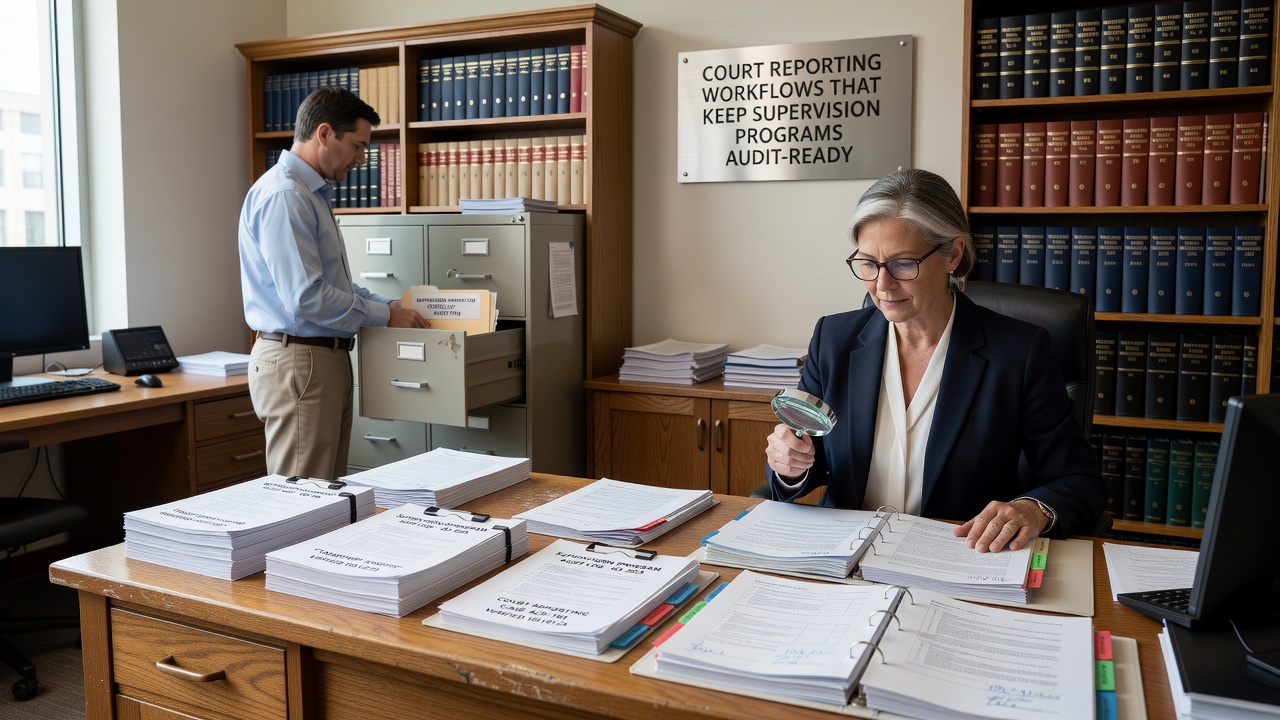
Staying audit-ready is one of the most consistent operational challenges for supervision and compliance agencies. For programs managing active caseloads, court reporting workflows are often the first place documentation gaps surface — and the last place you want them discovered. Whether the issue is a missing signature, a billing entry with no matching progress note, or a report submitted without verified attendance records, these gaps create real problems during reviews. Building reliable, repeatable workflows is the most practical way to prevent them.
Why Documentation Gaps Happen in the First Place
Most documentation problems are not the result of carelessness. They happen because staff are managing high caseloads with limited time, and there is no standardized system forcing consistency at each step.
The most common issues agencies encounter include:
- Missing or undated signatures on progress notes and consent forms
- Attendance records that do not match what was billed or reported to the court
- Incomplete completion evidence, such as missing certificates or unsigned step acknowledgments
- Gaps between billing entries and supporting documentation in the client file
- Progress notes that lack enough detail to support what was reported externally
When these problems accumulate across an active caseload, they become harder to catch before a report goes out — and much harder to explain after the fact.
What a Complete Client Compliance File Should Include
One of the most effective ways to prevent documentation problems is to define exactly what a complete file looks like, and then check every active file against that standard on a regular basis.
A well-structured compliance file should include the following elements:
Intake and Authorization
- Signed intake paperwork and referral documentation
- Court orders or referral conditions clearly on file
- Signed consent and release of information forms, all dated
Active Program Documentation
- Attendance logs that match session records and billing
- Progress notes for each session, consistently formatted and dated
- Evidence of completed program steps or milestones
- Any documented non-compliance, with dates and follow-up actions
Court and Probation Communication
- Copies of all reports submitted, with submission dates
- Responses or correspondence received from the court or probation officer
- Documented next reporting date or upcoming obligations
Discharge and Closure
- Completion certificate or documentation of early termination
- Final report submitted and acknowledged
- File closure checklist completed and signed
Having this structure in place gives staff a clear standard to work from and gives supervisors an easy benchmark during file reviews.
Building a Reporting Workflow That Reduces Errors
The most effective court reporting workflows for supervision programs share a few common characteristics: they are consistent, they include a second-review step, and they keep the report directly tied to the source record.
Use standardized report templates. A consistent format across all reports — same sections, same language structure, same required fields — makes it easier to catch what is missing before submission. It also makes comparison across cases faster during internal reviews.
Build in a second-review step before any external submission. Before a report goes to the court or a probation officer, a second staff member or supervisor should verify:
- Attendance records match what is reported
- Billing entries have corresponding progress notes
- Any completion claims are supported by file documentation
- Non-compliance is documented clearly and accurately
Keep court reports tied to the source file. When a report is generated from a separate process than the clinical or attendance record, mismatches are almost inevitable. Keeping these systems connected — or at minimum, requiring direct cross-reference before submission — eliminates the most common source of reporting errors.
Maintain a compliance calendar. Agencies managing multiple clients and multiple reporting obligations benefit from a shared calendar that tracks court deadlines, licensing deadlines, billing runs, and milestone-triggered reports. Without a centralized view, due dates get missed and reporting cycles fall out of sync.
How to Stay Audit-Ready Without Waiting for an Audit
Audit readiness is not something that can be reliably achieved by scrambling when a review is announced. It has to be built into routine operations.
Conduct internal file reviews on a regular cycle. Monthly or quarterly reviews of a sample of active files — checking for missing documents, unsigned entries, and record inconsistencies — catch problems when they are still easy to fix. A simple internal checklist is usually enough to guide this process.
A useful internal review checklist should check for:
- All forms present, signed, and dated
- Attendance logs current and consistent with billing
- Progress notes complete and formatted correctly
- No open items without documented follow-up
- Upcoming reporting obligations noted and calendared
Assign ownership to compliance tasks. When a task has no clear owner, it tends to fall through. Assigning specific staff members to recurring compliance responsibilities — such as running the monthly file check, sending reports by a set deadline, or flagging upcoming court dates — reduces the chance that something gets missed because everyone assumed someone else was handling it.
Standardize progress note formats. Progress notes that vary significantly in format, detail, or structure are harder to audit and easier to question. A consistent note format that ties clearly to attendance and program steps creates a traceable record that holds up during reviews.
Software tools designed for compliance tracking for regulated programs can help automate some of these routines — flagging missing documents, surfacing upcoming deadlines, and keeping attendance, billing, and reporting in alignment. For agencies managing complex caseloads, these tools reduce the manual coordination burden that makes audit readiness so difficult to sustain.
Preventing Billing and Paperwork Mismatches
One of the most frequently cited problems in regulated supervision programs is the mismatch between what is billed or reported and what is documented in the file. This is not always a compliance violation — but it looks like one, and it creates significant risk during an audit or a billing review.
The most effective prevention strategies are straightforward:
- Never bill for a session without a corresponding progress note in the file
- Run a regular reconciliation between billing records and attendance logs
- Document no-shows and cancellations clearly, including whether make-up sessions were completed
- Ensure completion reports are supported by actual documented milestones, not just staff recollection
For agencies using documentation tools for supervision agencies, many of these reconciliation steps can be built into the workflow itself, reducing the need for manual cross-checking.
Takeaway
Strong court reporting workflows for supervision programs are built on consistency, clear standards, and regular internal review — not on last-minute preparation. The agencies that stay audit-ready year-round are the ones that define what a complete file looks like, build a second-review step into every report, and check their own records before anyone else does. Modern software tools can support these workflows by keeping documentation, billing, and reporting in alignment and reducing the administrative load on staff. But the foundation is always the same: clear processes, consistent follow-through, and a team that knows exactly what is expected at each step.
—
Ready to strengthen your agency’s reporting and compliance workflows? Explore how purpose-built tools can help your team stay organized, reduce documentation gaps, and meet reporting obligations with confidence.