
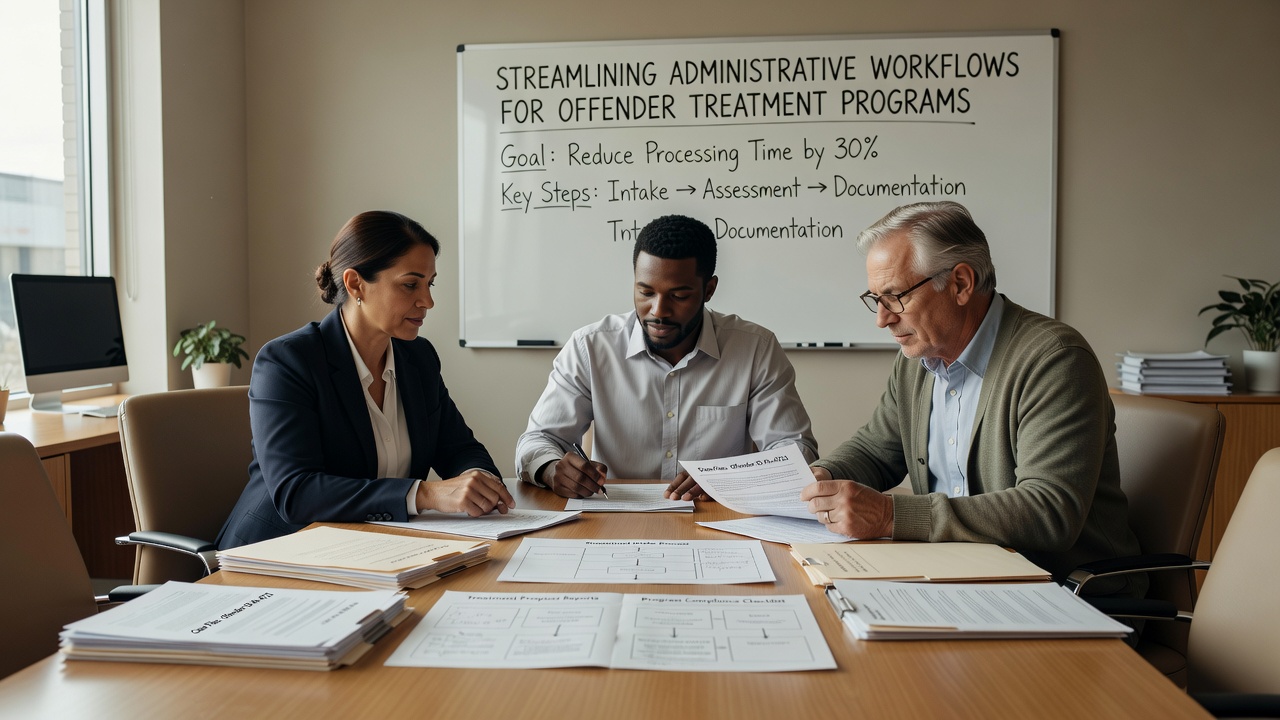
Managing administrative workflows for offender treatment programs is one of the most underestimated operational challenges in regulated supervision environments. Between documentation deadlines, compliance tracking, court reporting, and billing requirements, staff often spend more time on paperwork than on direct client support. The good news is that clear processes, standardized templates, and purpose-built software tools can reduce that burden significantly — without sacrificing accuracy or audit defensibility.
Why Administrative Workflows Break Down in Regulated Programs
Most workflow problems in supervision and treatment settings don’t start with bad intentions. They start with inconsistency. When staff members document differently, use different status labels, or follow different escalation steps, small gaps accumulate into larger compliance risks.
Common pressure points include:
- Missed or late session notes that fall outside required documentation windows
- Inconsistent client status labels that make it difficult to track noncompliance trends across a caseload
- Manual reporting processes that require staff to re-enter data across multiple systems
- Audit preparation that happens reactively rather than as part of a regular review cycle
These aren’t signs of staff failure — they’re signs of workflow design problems. When the process itself is unclear or overly manual, even experienced staff will produce inconsistent results.
How to Build a Documentation Workflow Staff Will Actually Follow
The most effective documentation systems are ones that reduce friction, not add to it. If your current process requires staff to remember too many steps or navigate too many disconnected tools, compliance will suffer regardless of effort.
Start with standardized templates
Structured templates reduce the cognitive load on staff and make it harder to accidentally omit required information. A well-designed session note template, for example, should prompt for key fields — date, session type, participant status, next scheduled contact — without requiring staff to remember every required element from scratch.
Protect time for documentation
One of the most practical administrative workflow improvements any program can make is treating documentation time as non-negotiable. When staff are expected to complete notes between back-to-back sessions or after hours, quality and timeliness both decline. Building documentation windows into daily schedules is a process change that costs nothing but produces measurable improvements in note completeness.
Centralize your records
When case notes, incident reports, compliance flags, and court documentation live in separate places — spreadsheets, shared drives, email threads — staff spend unnecessary time locating information and reconstructing timelines. Centralizing records in a single system makes it easier to respond to court requests, complete chart reviews, and demonstrate compliance during audits.
Compliance Tracking Best Practices for Supervision Caseloads
Tracking compliance across a caseload requires more than just noting whether a participant attended their last session. Effective compliance monitoring means maintaining a consistent, real-time picture of each participant’s status — and being able to act quickly when that status changes.
Key practices include:
- Standardizing status categories so that every staff member uses the same language to describe the same situation (e.g., “noncompliant,” “at risk,” “compliant with conditions”) — this matters both internally and when communicating with courts or referring agencies
- Tracking trends over time, not just point-in-time status — a participant who has missed two of the last four sessions represents a different risk profile than one who missed a single session six months ago
- Building escalation checkpoints into the workflow so that noncompliance triggers a documented response, not just a mental note
- Logging contact attempts in real time rather than reconstructing them later — this is especially important for audit defensibility
Software tools designed for compliance tracking in regulated programs can automate many of these steps, flagging overdue notes, tracking attendance patterns, and generating status reports without requiring manual data pulls.
Staying Audit-Ready Without Last-Minute Scrambles
For most programs, audit preparation is reactive — triggered by an upcoming review rather than maintained as an ongoing practice. This creates unnecessary stress and increases the risk of findings that could have been avoided with routine checks.
A more sustainable approach is to build audit readiness into your regular operational calendar.
Monthly chart reviews
A simple monthly chart review process — even a sample check of 10 to 15 percent of active cases — can surface documentation gaps before they become audit findings. Reviewers should check for:
- Note timeliness — are session notes completed within the required window?
- Required fields — are all mandatory elements present in each note type?
- Escalation documentation — when a participant was flagged as noncompliant, is there a documented response?
- Court report accuracy — do report contents match the underlying case notes?
Keep a running compliance log
Rather than assembling documentation from scratch when an audit arrives, maintaining a running log of compliance activities — trainings completed, policy updates, corrective actions taken — gives you a defensible record that’s always current.
Reducing Billing Errors Through Better Documentation Habits
Billing problems in regulated programs are often downstream documentation problems in disguise. When session notes are incomplete, late, or missing required fields, claims may be denied, delayed, or flagged for review. The fix isn’t always in the billing system — it starts with the documentation workflow.
Clean, complete, timely notes are the foundation of clean claims. Programs that invest in documentation quality — through training, templates, and regular review cycles — tend to see measurable improvements in billing performance over time.
Practical steps that connect documentation to billing outcomes:
- Require session notes to be completed and signed before a claim is submitted for that session
- Build pre-billing documentation checks into your billing workflow as a standard step
- Track denial reasons over time to identify recurring documentation gaps that may be addressable through template or process changes
- Use administrative workflow tools built for court ordered programs to link documentation completion to billing readiness — reducing the manual reconciliation step that slows many programs down
Takeaway
The administrative challenges facing offender treatment and supervision programs are real, but most of them are solvable through clearer processes, standardized documentation, and consistent review habits. Whether your program is preparing for an audit, trying to reduce staff overtime, or working to improve billing performance, the starting point is usually the same: look at your workflow before you look at your staffing.
Modern software tools can support every layer of this work — from structured note templates and compliance tracking to automated reporting and billing integration. But technology works best when it reinforces a well-designed process, not when it’s expected to replace one.
If your team is ready to evaluate how your current administrative workflows are performing, start with a documentation audit of your own: pull a sample of recent notes, check for completeness, and ask where the gaps are. That single exercise will tell you more than any checklist can.