
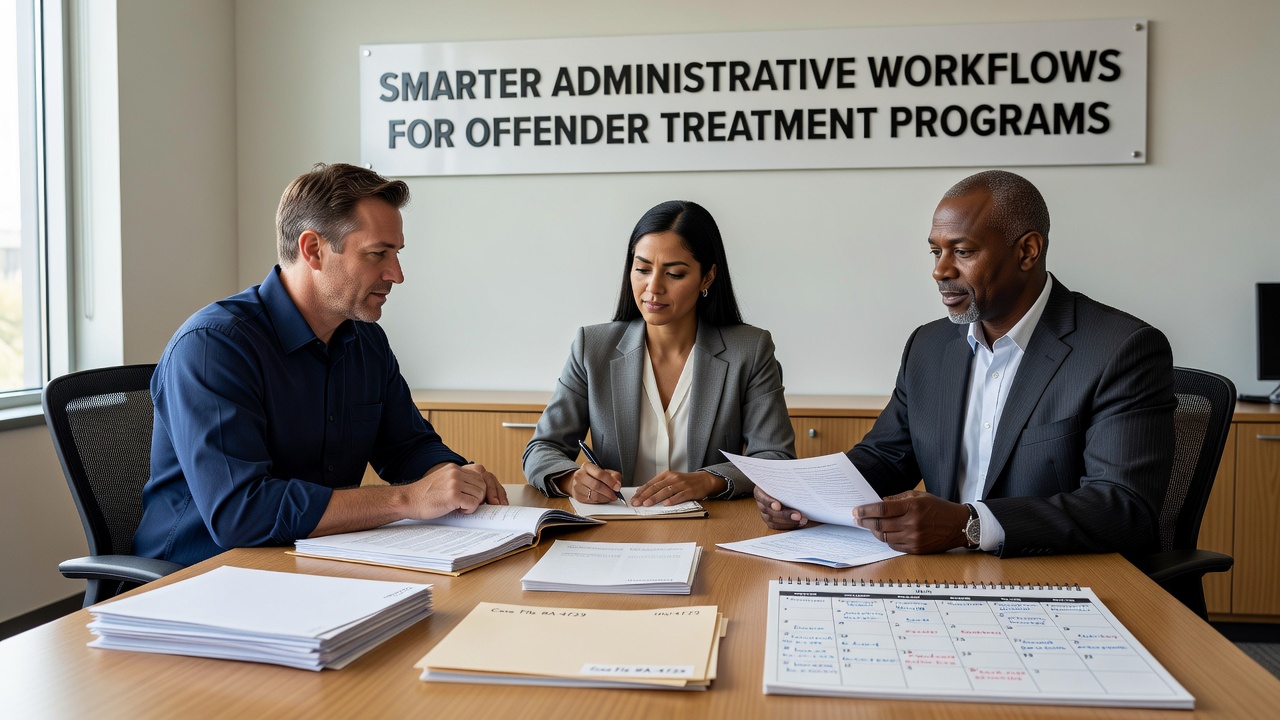
Managing compliance in a regulated supervision environment means juggling case documentation, court reporting, billing, and audit readiness — often with a small team and limited time. For agencies that support treatment and supervision programs, administrative workflows for offender treatment programs are the backbone of daily operations. When those workflows are well-designed, staff spend less time scrambling and more time serving clients. When they aren’t, even minor documentation gaps can trigger audit findings or billing denials.
This guide outlines practical workflow improvements that help agencies stay organized, reduce administrative burden, and stay defensible when it matters most.
Why Documentation Errors Create Bigger Problems Downstream
Poor documentation is one of the most common — and most preventable — sources of compliance risk for supervision and treatment agencies. Errors that seem minor in the moment can lead to billing denials, failed audits, or disputes about whether services were actually delivered.
Some of the most frequent documentation issues include:
- Missing links between diagnosis, service, and intervention — Every session note should connect the presenting need, the service delivered, and how that service addressed the need. A record that documents attendance but not clinical or programmatic necessity leaves auditors with unanswered questions.
- Incomplete time tracking — For billing purposes, records that lack start and stop times may fail to support the units billed. This is especially common when staff complete notes after the fact without a structured template.
- Missing signatures, credentials, or dates — A completed form without a staff signature and credential isn’t a complete record. These details are often the first thing reviewers check.
- Vague or generic session notes — Notes that describe what happened without explaining why it was clinically or programmatically appropriate are difficult to defend in an audit.
Building templates and checklists into your documentation process — rather than relying on staff memory — significantly reduces these errors over time.
How to Build Audit-Ready Administrative Workflows
Audit readiness shouldn’t be a once-a-year sprint. The agencies that handle audits most smoothly are the ones that treat compliance as an ongoing workflow, not a special event.
Use a Single Source of Truth for Case Records
Fragmented records — spread across paper files, email threads, and multiple spreadsheets — create both operational inefficiency and legal exposure. When the same information exists in multiple places, it’s easy for versions to fall out of sync. When an auditor asks for documentation, staff spend hours reconstructing a paper trail that should already exist in one place.
A centralized case record system ensures that attendance logs, treatment plans, contact notes, and violation reports are all stored together, with a consistent format and a clear audit trail showing who entered what and when.
Bind Documentation to Policy Objectives
Every data point your agency collects — a session note, a UA result, a court contact — should connect to a defined policy or compliance requirement. This is sometimes called mapping your documentation to your obligations. When each record type has a named owner and a clear purpose, gaps are easier to spot and easier to correct before they become findings.
Practical steps to get there:
- Create a documentation matrix that maps each record type to the requirement it satisfies
- Assign responsibility for each record type to a specific role, not just a person
- Review the matrix at least annually to catch any changes in reporting requirements
Preserve Timestamps and Exception History
Auditors don’t just want to know what happened — they want to know when it happened and how exceptions were handled. If a client missed a required session, what was the documented response? Was it escalated? Was a sanction applied? Was it noted in the case file?
Workflows that automatically log timestamps, record exception decisions, and track follow-up actions give agencies a far stronger position in any review.
Compliance Tracking: Moving From Ad Hoc to Structured Monitoring
Many agencies track compliance obligations informally — a shared calendar here, a sticky note reminder there. This works until it doesn’t. A structured compliance tracking workflow is more reliable and far easier to defend.
Map Obligations to Cases and Roles
Start by listing every recurring compliance obligation your program carries: treatment sessions, UA tests, classes, court appearances, reporting deadlines. Then map each obligation to the relevant case type, location, and staff role. This creates a framework where nothing falls through the cracks because someone was out sick or a handoff wasn’t communicated.
Define Warning Windows and Grace Periods
Build reminder logic into your workflow with clear lead times. For example:
- A 30-day reminder before a required compliance milestone
- A 7-day alert when a deadline is approaching with no activity logged
- A defined grace window after a missed event, with a documented escalation path
These aren’t just operational conveniences — they’re defensible evidence that your agency takes compliance monitoring seriously.
Reporting Workflows That Reduce the Monthly Fire Drill
For many agencies, monthly or quarterly reporting feels like starting from scratch every time. Staff manually pull records, cross-check spreadsheets, and compile summaries under deadline pressure. This is both inefficient and error-prone.
Better reporting workflows share a few common features:
- Clear metrics defined upfront — Know what you’re reporting before the reporting period starts. Completion rates, violation patterns, enrollment status, and waitlists should be defined as standard outputs, not assembled differently each month.
- Consolidated data sources — When records live in one system, reports can be generated from that system rather than reconciled across multiple sources. This alone eliminates a significant source of manual work.
- Layered outputs — Judges and program stakeholders often need a visual summary: completion percentages, status flags, trend indicators. Staff and auditors need the detailed log underneath. Good reporting workflows produce both from the same dataset.
Using administrative workflow tools for court ordered programs can help agencies centralize this process and reduce the time spent on manual compilation each reporting cycle.
What Belongs in a Defensible Audit Trail
An audit trail is more than a log of who logged in when. For supervision and treatment agencies, a useful audit trail documents:
- Changes to case conditions — If a treatment plan was modified, when was it changed, by whom, and what triggered the update?
- Violation identification and response — When a non-compliance event occurred, what was documented at the time? What action was taken and when?
- Scheduling and attendance records — With timestamps that support the accuracy of billing and reporting outputs
- Staff credential and signature history — So records can be attributed to qualified personnel
Agencies that use purpose-built compliance tracking for regulated programs typically find it easier to maintain this kind of structured audit trail because logging is built into the workflow rather than added as an afterthought.
Takeaway
The difference between an agency that struggles through audits and one that handles them with confidence usually comes down to workflow design, not effort. When documentation templates are consistent, compliance obligations are tracked systematically, and case records are centralized in a single auditable system, administrative burden goes down and defensibility goes up. Modern software tools give supervision and treatment agencies the infrastructure to maintain this standard without adding staff or increasing workload — they just require intentional setup and a commitment to structured processes.
Ready to reduce administrative overhead and improve your compliance workflows? Explore how purpose-built tools for supervision and treatment programs can help your team stay organized and audit-ready year-round.