
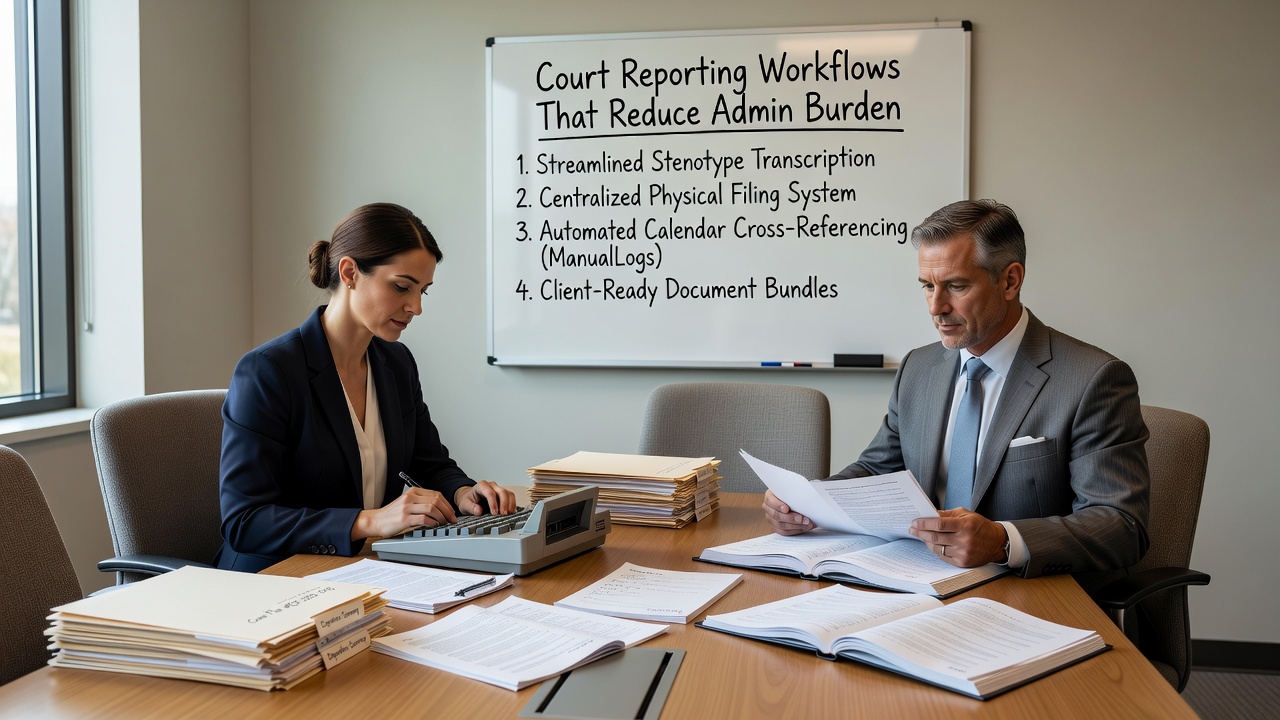
Keeping up with court reporting workflows for supervision programs is one of the most time-consuming operational challenges agencies face. Between documentation requirements, regulatory deadlines, billing accuracy, and audit readiness, the administrative load can quickly overwhelm staff and introduce compliance risk. The good news is that most of these pressures can be reduced with better-designed workflows, standardized templates, and the right software tools.
This guide covers practical strategies for improving how your agency handles reporting, documentation, compliance tracking, and billing — without adding headcount or increasing complexity.
Why Reporting Workflows Break Down
Most agencies don’t struggle with compliance because they’re not trying. They struggle because their workflows weren’t designed with scale or oversight in mind. Common breakdowns include:
- Inconsistent documentation templates across staff or programs, leading to missing information and uneven quality
- Delayed note completion, which increases audit exposure and makes it harder to reconstruct what actually happened during a session or appointment
- Redundant data entry across disconnected systems, which wastes time and introduces errors
- No clear escalation process when a client misses a required appointment or triggers a reporting obligation
These aren’t isolated problems. They tend to compound. A delayed note leads to a documentation gap. A documentation gap creates a billing discrepancy. A billing discrepancy surfaces during an audit. Understanding how these issues connect is the first step toward fixing them.
How Standardized Templates Improve Reporting Quality
One of the most effective ways to reduce administrative burden is to standardize the structure of your notes and reports. When staff work from consistent templates, several things improve at once.
Templates reduce decision fatigue. When a staff member doesn’t have to determine which fields to include each time, they complete documentation faster and more accurately.
Standardized notes are easier to audit. Reviewers know exactly where to look for required elements — date, duration, presenting issue, intervention used, client response, and connection to the treatment plan.
Reusable language for common interventions speeds up report generation without sacrificing accuracy. Staff can focus on what changed, rather than rewriting standard language from scratch.
For programs that submit regular reports to courts or oversight bodies, this consistency is especially important. A well-structured template ensures that required information is never accidentally omitted.
Building an Audit-Ready Documentation Practice
Audit readiness isn’t something you prepare for once a year. It’s an operational discipline that needs to be built into how your agency works every day.
Create a Centralized Document Repository
All policies, client records, court correspondence, monitoring logs, and incident reports should live in one accessible location. When an auditor or oversight body requests records, your team should be able to respond quickly and completely — not spend days hunting across shared drives, email threads, or paper files.
Establish a Regular Review Cadence
A sustainable audit-readiness calendar might look like this:
- Weekly: Spot-check a small number of recently completed notes for required elements
- Monthly: Sample a broader set of charts to identify patterns or gaps
- Quarterly: Review compliance KPIs — note completion rates, timeliness of required reports, attendance documentation
- Annually: Conduct a full compliance review across all active programs
This kind of rhythm prevents small problems from becoming large ones and gives leadership early visibility into where training or process changes are needed.
Maintain Audit Logs
Audit logs that track actions, edits, and approvals are a critical but often overlooked part of compliance infrastructure. They demonstrate that controls are operating as intended — not just that the right policies exist on paper.
Compliance Tracking Best Practices for Regulated Programs
Effective compliance tracking means more than checking whether clients are showing up. It means maintaining structured, consistent records that demonstrate supervision is happening — and that your agency can prove it.
Some practical approaches:
- Define a risk-based monitoring framework. Higher-risk clients should receive more frequent documentation, more intensive tracking, and more detailed notes. Lower-risk cases may require less oversight, freeing up staff time.
- Track key compliance metrics in one place. Attendance rates, timeliness of required submissions, treatment adherence, and documentation completeness are all meaningful indicators. Dashboards that surface these at a glance help supervisors catch problems before they escalate.
- Use role-based access controls. Staff should only see the data they need for their specific duties. This supports both privacy compliance and internal accountability.
- Log monitoring activities consistently. A centralized log of supervision events, case reviews, and compliance checks demonstrates that oversight is ongoing — not just reactive.
For agencies using compliance tracking tools for regulated programs, many of these practices can be supported directly within the platform rather than managed through separate spreadsheets or manual processes.
Fixing Billing and Paperwork Bottlenecks
Billing errors in regulated supervision programs are rarely the result of fraud. More often, they stem from documentation gaps that weren’t caught before a claim was submitted.
The most common culprits include:
- Progress notes that don’t support the billed service. If a note lacks the required time, intervention description, and client response, it can’t justify the corresponding billing code.
- Mismatched diagnoses and treatment types. When ICD-10 diagnoses aren’t clearly linked to CPT codes in the treatment plan, claims get denied and staff spend hours on rework.
- Missing medical necessity language. Regulators and payers want to see documentation that explains why a service was clinically appropriate — not just that it occurred.
The fix isn’t just training, though training helps. It’s building note structures that prompt staff to include required billing elements before a session is closed. When the template includes the right fields and the system flags incomplete notes before submission, billing accuracy improves without relying entirely on individual staff vigilance.
Agencies that handle complex billing alongside documentation requirements may also benefit from administrative workflow tools for treatment providers that connect note completion to billing workflows directly.
Takeaway
The operational challenges facing supervision agencies — documentation gaps, audit risk, reporting delays, and billing errors — share a common root cause: workflows that weren’t designed to scale or to meet regulatory expectations. Fixing these problems doesn’t require a complete overhaul. It starts with standardizing templates, establishing consistent review practices, centralizing records, and using software that connects documentation to compliance and billing in one place. When your workflows are structured and your records are complete, audit readiness becomes a natural byproduct of how your agency operates — not a scramble that happens when oversight knocks on the door.
Ready to see how better workflow tools can support your agency’s reporting and compliance needs? Schedule a demo to explore how purpose-built software can reduce administrative burden and help your team stay audit-ready year-round.