
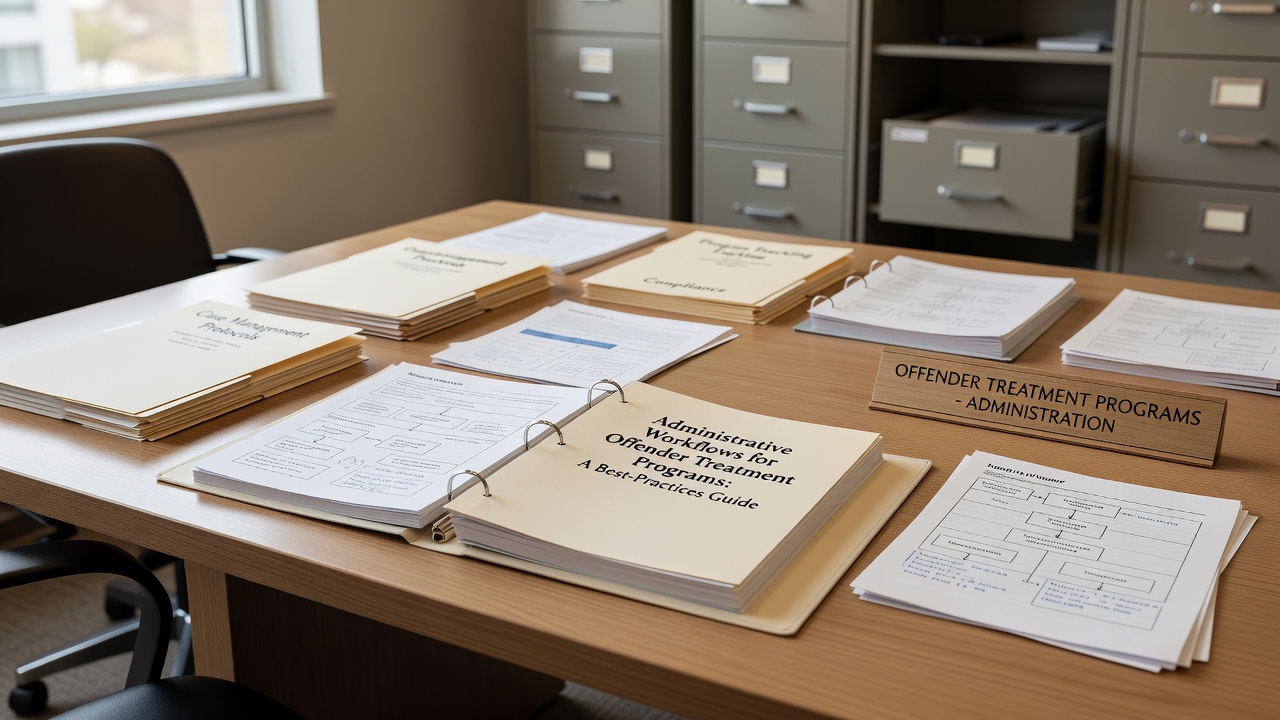
Managing administrative workflows for offender treatment programs is one of the most overlooked operational challenges for agencies working in regulated supervision environments. Between documentation requirements, compliance obligations, court reporting, and billing processes, the administrative load on staff can become a significant barrier to delivering quality services. The good news is that well-designed workflows — supported by the right tools — can reduce that burden while keeping your agency audit-ready and operationally sound.
Why Administrative Workflows Matter in Regulated Programs
Agencies serving justice-involved clients operate under multiple overlapping requirements: state licensing rules, payer documentation standards, court-mandated reporting, and federal regulations like HIPAA and 42 CFR Part 2. When workflows are unclear or inconsistent, the consequences go beyond inconvenience.
Poor documentation practices create audit risk, billing denials, and potential compliance violations. Inconsistent intake procedures lead to missing forms, unsigned releases, and incomplete records that become problems during licensing reviews or payer audits. Disorganized reporting processes mean staff spend hours pulling together information that should be readily available.
The goal of strong administrative workflows is not just efficiency — it is operational reliability. When your processes are consistent, your records are defensible, and your reporting is timely.
Common Documentation Mistakes and How to Prevent Them
Documentation errors are among the most common compliance findings in regulated supervision and treatment programs. Understanding where these errors originate helps agencies build better prevention into their workflows.
Mistakes That Create the Most Risk
- Missing required elements such as client signatures, consent forms, or date-of-service documentation
- Inconsistent or vague progress notes that do not clearly describe the intervention provided or the client’s response
- Copy-pasting from prior sessions without updating relevant clinical detail
- Late or back-dated entries that raise questions during audits or court review
- Inadequate justification for the level of care billed or the services rendered
The fix for most of these issues is standardization. Using structured note templates — such as SOAP or DAP formats — gives clinicians a consistent framework. Building required fields directly into intake packets and progress note workflows ensures that nothing is skipped. When documentation structure is part of the process, compliance becomes easier to maintain.
Another practical step is building intake checklists that capture everything up front: court orders, referral forms, conditions of supervision, releases of information, payment agreements, and identity verification. Errors caught at intake are far less costly than errors discovered during a payer audit or licensing review.
Building Compliance Into Your Reporting Workflows
For agencies providing supervision-related services, court and probation reporting is a routine but time-intensive task. Standardizing these workflows can significantly reduce the administrative hours required while improving accuracy.
Structured data collection is the foundation of efficient reporting. When client information — attendance, participation, progress milestones, noncompliance events — is captured consistently in structured fields, generating reports becomes a matter of pulling existing data rather than reconstructing it from scattered notes.
Organizations that rely on administrative workflow tools for court ordered programs often find that the biggest time savings come not from generating reports faster, but from having the underlying data organized and accessible in the first place.
Practical reporting workflow improvements include:
- Creating report templates aligned with local court expectations so staff are not reformatting documents for each submission
- Using batch or scheduled reporting for recurring court updates rather than handling each one individually
- Maintaining a reporting calendar that tracks submission deadlines across all active clients and referral sources
- Documenting all disclosures and consent decisions, particularly when sharing clinical information with justice partners under 42 CFR Part 2
Staying Audit-Ready Without Overloading Staff
Many agencies treat audits as exceptional events — something to prepare for when a notice arrives. A more effective approach is to build audit readiness into daily operations so that the records, documentation, and reports needed for a review are always current.
This starts with an internal audit calendar. Scheduling regular chart reviews, billing audits, and documentation spot-checks throughout the year — rather than only when prompted — keeps problems from accumulating. Agencies that conduct mock audits using the same criteria that state licensors or payers apply tend to catch issues early, when they are easier and less costly to correct.
Key components of continuous audit readiness:
- Record retention policies that reflect state licensing, Medicaid, and grant-specific requirements
- Organized electronic and paper records that can be located and produced quickly in response to a data request
- Documentation of compliance activities such as staff training, policy reviews, and internal audits — this itself becomes part of the audit record
- Secure destruction procedures with documented destruction events for records that have met their retention period
For smaller agencies without a dedicated compliance officer, assigning a compliance contact — even in a part-time capacity — ensures that someone is accountable for monitoring these activities consistently.
Using Data to Improve Program Performance
Beyond compliance, well-organized administrative workflows create the foundation for meaningful performance monitoring. Agencies that track key metrics consistently are better positioned to identify problems early, demonstrate outcomes to funders, and make informed decisions about capacity and resources.
Core metrics worth tracking in supervised treatment programs include:
- Client attendance and participation rates across sessions and program phases
- Completion and discharge status by program type and referral source
- Noncompliance events and how quickly they were reported to the appropriate party
- Billing submission and denial rates to monitor revenue cycle health
When this data is captured through structured workflows — rather than assembled manually from disparate records — it becomes usable for both internal decision-making and external reporting. Compliance tracking tools for regulated programs can help agencies maintain this kind of organized, accessible data environment without requiring significant manual effort from staff.
Dashboards that surface these metrics in real time allow program managers to spot attendance bottlenecks, flag clients approaching noncompliance thresholds, and respond before small issues become reportable violations.
Takeaway
Strong administrative workflows are not a luxury for agencies managing regulated supervision and treatment services — they are a core operational requirement. Consistent intake processes, defensible documentation practices, standardized reporting, and ongoing audit readiness reduce risk, support compliance, and free staff to focus on the work that matters most.
Modern software tools designed for this environment make it significantly easier to maintain structured workflows, generate accurate reports, and keep records audit-ready without adding administrative burden. Whether you are managing documentation, tracking compliance across a caseload, or preparing for a licensing review, the right process infrastructure makes all the difference.
If your agency is evaluating ways to improve administrative efficiency and compliance tracking, explore how purpose-built tools can support your team’s day-to-day workflows.