
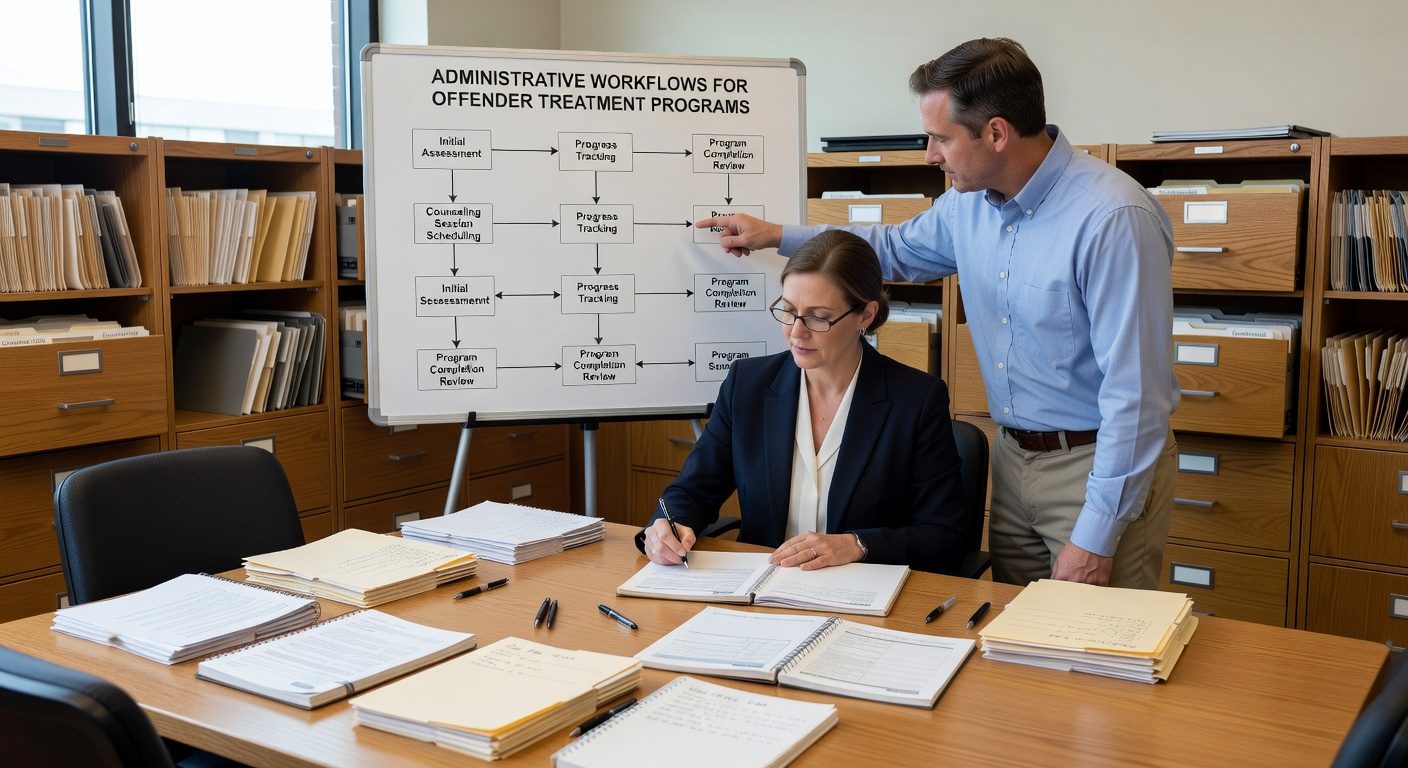
When supervision agencies and treatment providers rely on manual processes for compliance tracking, documentation management, and reporting requirements, administrative workloads quickly become overwhelming. Modern administrative workflows for offender treatment programs can significantly reduce staff burden while improving accuracy and audit readiness.
Understanding Administrative Workflow Challenges
Most supervision agencies struggle with disconnected systems that require staff to enter the same information multiple times across different platforms. Treatment providers often juggle clinical documentation, billing records, compliance tracking, and court reporting through separate manual processes.
This creates several operational problems:
• Data entry errors from repeated manual input across multiple systems • Missing deadlines for required reporting when tracking relies on paper calendars or basic spreadsheets • Audit preparation stress when records exist in multiple locations without centralized access • Staff overtime spent on administrative tasks instead of participant services
The challenge intensifies when agencies serve justice-involved individuals with co-occurring disorders, where regulatory requirements overlap between criminal justice, substance use treatment, and mental health compliance standards.
Streamlining Documentation and Record Management
Effective documentation workflows start with centralized record systems that automatically track required information without duplicate data entry. Instead of maintaining separate files for treatment notes, compliance reports, and billing documentation, integrated systems allow staff to enter information once and generate multiple required outputs.
Essential Documentation Automation Features
Modern workflow improvements include:
• Automated progress tracking that pulls data from treatment sessions to populate required reports • Digital consent management with time-stamped signatures and automatic renewal alerts • Integrated billing workflows that capture treatment codes during documentation rather than requiring separate entry • Compliance deadline tracking with automated reminders for required submissions
For agencies handling substance use disorder records, Part 2 compliance workflows become particularly important. Rather than managing paper consent forms and manual disclosure logs, digital systems can track every record release with recipient details, dates shared, and legal basis for disclosure.
Improving Compliance Monitoring Efficiency
Continuous compliance monitoring represents a significant workflow improvement over traditional periodic review processes. Many agencies still rely on annual background checks and quarterly license verifications performed manually by administrative staff.
Automated compliance workflows can monitor:
• Federal exclusion list updates that occur daily rather than waiting for annual staff reviews • Professional license status changes with real-time alerts for suspensions or restrictions • State database checks including child protective services and adult protective services registries • Multi-jurisdiction coordination for remote workers or participants crossing state lines
Reducing Administrative Burden Through Systematic Monitoring
Rather than assigning compliance tracking to individual staff members who must remember to check various databases, systematic monitoring workflows can automatically verify staff credentials and participant eligibility on predetermined schedules.
This approach prevents compliance gaps while reducing the administrative workload on program coordinators and supervisors. Staff receive alerts only when action is required, rather than spending time on routine verification tasks that systems can handle automatically.
Building Audit-Ready Reporting Systems
Audit preparation often creates significant stress for agencies because required documentation exists across multiple systems without centralized access. Integrated reporting workflows address this challenge by maintaining comprehensive audit trails throughout normal operations.
Key audit readiness features include:
• Role-based access logging that tracks who accessed which records and when • Automated backup systems that prevent data loss and ensure record retention compliance • Standardized report generation that produces consistent formatting for regulatory submissions • Real-time compliance dashboards showing current status across all required areas
Proactive Audit Management
Instead of scrambling to compile documentation when audits are announced, agencies can maintain continuous audit readiness through systematic workflow design. This means having all required reports available on-demand rather than requiring special preparation periods.
Proactive audit management also includes regular internal compliance reviews using the same systems and processes that external auditors will examine. This allows agencies to identify and address potential issues before formal audits occur.
Technology Integration for Administrative Efficiency
Modern administrative workflows leverage technology integration to eliminate redundant tasks and improve accuracy. Rather than using separate systems for scheduling, documentation, billing, and reporting, integrated platforms allow information to flow seamlessly between functions.
Effective technology integration includes:
• Electronic signature capabilities that speed up consent processes and reduce paper handling • Automated appointment reminders that reduce no-shows and improve treatment compliance • Integrated laboratory results that automatically update treatment records and trigger required notifications • Mobile access options that allow staff to update records during field visits or court appearances
Staff Training and Workflow Adoption
Successful workflow improvements require adequate staff training and gradual implementation strategies. Rather than attempting to change all processes simultaneously, agencies achieve better results by prioritizing the most time-consuming manual tasks for initial automation.
Training should focus on how new workflows reduce administrative burden rather than adding complexity to existing processes. When staff understand that technology improvements will give them more time for direct participant services, adoption becomes much smoother.
Measuring Administrative Workflow Success
Agencies should track specific metrics to evaluate workflow improvements and identify areas needing additional attention. Key performance indicators include:
• Time spent on administrative tasks compared to direct service delivery • Error rates in documentation and compliance reporting • Audit preparation time required for regulatory reviews • Staff overtime hours dedicated to administrative work • Compliance deadline adherence across all required reporting areas
Regular measurement allows agencies to demonstrate the value of workflow improvements to stakeholders and identify opportunities for continued optimization.
Takeaway
Effective administrative workflows for offender treatment programs reduce staff workload while improving compliance accuracy and audit readiness. By implementing integrated documentation systems, automated compliance monitoring, and streamlined reporting processes, agencies can redirect staff time from administrative tasks to direct participant services. Modern software solutions that centralize record management, automate routine compliance checks, and generate required reports on-demand help supervision agencies maintain regulatory requirements without overwhelming their staff. The key to successful implementation lies in prioritizing the most time-consuming manual processes for initial improvement and providing adequate training to ensure smooth adoption.
Ready to reduce administrative burden while improving compliance accuracy? Explore how administrative workflow tools for court ordered programs can streamline your agency’s documentation, monitoring, and reporting processes.